Showing posts with label Animals. Show all posts
Saturday, October 13, 2012

On Dasher...

Never ask a Sámi person how many reindeer they have.  We couldn't help but wonder, though, as we stayed on a reindeer farm in Sevettijärvi, would we get to see any?  How many are there around?  There were droppings on the property, confirming their existence and Merlin could tell that they were fresh enough to signal close reindeer proximity.  Those are true country boy skills right there.  But a reindeer 'farm' is very different than the name implies.  These are wild animals, only partially domesticated.  To keep your reindeer is to follow them, gather them, mark them, not confine them.  So, did we see any reindeer?  We sure did.  This is the land of the reindeer, far above the Arctic Circle and even mating season (which it was while we were in Lapland) couldn't keep the reindeer completely out of sight. 
To ask about the number in someone's herd would be like saying, "hey, how much money have you got in the bank?"  Until very recently, reindeer husbandry was the core of the Sámi economy.  The animals were a currency.  In fact, when we asked one of the older schoolchildren in Sevettijärvi why the language textbook they'd sweetly presented us with had a picture of small reindeer bones on the cover, we were told that those were game pieces.  "It is a Skolt game," the thirteen year old explained.  You throw them on the ground and whichever ones land a certain way are reindeer.  "Whoever has the most reindeer wins."  So, basically, it's a very ancient version of Monopoly.  Until the 1600s, Sámi people lived as nomads, following reindeer as they migrated.  These journeys brought them over borders, being defined at that time as Russia, Sweden and Denmark.  The governments of each (and sometimes all three) began to tax the Sámi people and, with no hard currency, they paid with hides and meat.  The need to generate more income in order to pay taxes led to over-hunting and a sharp decrease in the number of reindeer.  There was a threat of extinction.
Many Sámi chose to settle along fjords and switch mainly to fishing.  Others decided to employ the same methods they'd seen Scandinavian shepherds use with their flocks of sheep.  The men began taming small groups of reindeer and herding them from place to place as needed.  The women made clothing and blankets from the fur, boots from the skins, tools from antlers and even cheese from the reindeer's milk.  These reindeer herders, though a minority, became what is now seen as the 'archetypical' Sámi.  As systematic (and sometimes sadistic - in cases of female sterilization) assimilation measures were taken by Scandinavian and Russian governments, the communities most reliant on reindeer husbandry were the ones who held on most tightly to their culture.  There's a direct correlation between the survival of Sámi dialects and traditions and the importance of herding in those communities.  You can pretty much safely put the reindeer at the center of modern Sámi identity. 
Of course, they also ate the meat.  While you'd probably be hard pressed to find any reindeer milk products around Lapland, reindeer meat is very common.  Most often, it is sauteed, resembling beef stir fry or cheese steak shavings, served with lingonberries and potatoes.  For some reason that we can't figure out, the reindeer in Lapland tastes much more like beefsteak than venison.  There is no gaminess and the flesh is tender enough to not necessitate it being cooked super rare.  Other common preparations are dried and cured sausages, sliced thin and eaten as a breakfast and lunch meat.  Reindeer soup made some appearances as well.  Canned reindeer stew, reindeer chunks and reindeer meatballs showed up all around Finland - not just Lapland.  It has grown from being a local delicacy to a national culinary tradition, as Sámi culture has become more widely accepted and respected in recent decades.
Above, a particularly delicious baked reindeer steak with rye and thyme crumble, forest mushrooms and artichoke puree.  This was at Ravintola Aanaar in Inari.  The town is considered the center of Sami culture in Finland.  Merlin ate this (and I had Lake Inari whitefish) in a small dining room adjacent to the main banquet hall.  A group of around 50 people had been filing in all evening and now sat enjoying a meal and some live, traditional music.  "Is it a wedding?" we asked.  "Oh, no.  Just a gathering of Sámi people."  Many had arrived in traditional costume, some wore name tags.  "It happens all the time."   Inari is also home to Siida, a really wonderful museum dedicated to Sámi culture and the nature of Northern Lapland.  Siida is a North Sámi word for a reindeer village and much of the permanent exhibition, naturally, was dedicated to herding and husbandry. 
This old record book shows a series of earmarks and the families and family members they represent.  Every summer, the calves that are born the spring before are rounded up and small cuts and patterns are made in their ears.  This marks ownership.  Thousands of earmarks exist, children have different ones than their parents, siblings and so on.  The best herders earn the most intricate patterns, Natalia explained to us.  "Mine was one no one wanted."  She owned some reindeer (of course, we didn't ask how many) at one point.  Her earmark pattern was simple enough that it could easily be turned into another.  So, one by one, her reindeer began to disappear.  Finally, she sold them off before she had none left.  "I knew who it was and was mad for a while.  But it is all a part of it."  She told us of the skill involved with knowing exactly where to find every one of your reindeer depending on the wind, the surface of the snow, how old they are.  The Sámi have hundreds of words for 'reindeer,' including one for each year of a reindeer's life.
Only around 10% of today's Sámi count reindeer husbandry as their primary source of income.  That doesn't make the animals any less important, though.  Tourism in Lapland depends a lot on people wanting to come up and see Dasher and Dancer et al.  At our homestay, Natalia told us about Spaniards zipping around on snowmobiles they'd never ridden before, trying to find some reindeer.  "I was running around with a first aid kit."  Other guests think that going right up to one and petting it is a good idea.  "They even think they can ride them!"  Most tourist material for the area involves snowmobile and dog-sled tours to go out and spot some reindeer.  Thankfully, absolutely nowhere is there the opportunity to go out on a hunt.  I was happy to see some of the beautiful animals, even if they were just fleeting glances.  And, at night, I even dreamed of reindeer (though our pillowcases may have had something to do with that).
You have read this article Animals / Countryside / Farms / Finland / History / Museums with the title Animals. You can bookmark this page URL https://africathoughts.blogspot.com/2012/10/on-dasher.html. Thanks!
Sunday, September 16, 2012

Seljord Dyrsku’n Days

In the granite mountains in the heart of Norway, where the fields are rocky and the pine trees grow thick, we wandered for hours among antique tractors and penned sheep.  We ate heavy food, breathed in country air, listened to the music and voices of tradition.
Festivals and country fairs are a traveler's holy grails.  There is always a lot to see, there's always plenty of "culture," there are opportunities for photos and good food, strange happenings and chances to really get at a country's soul.  So we made sure to make it to the Seljord Dyrsku’n, the largest farm festival in Norway and a perfect way to begin the Autumn.
In a beautiful courtyard, with the red, blue and white Norwegian flag flapping overhead, proud farmers showed off their husbandry, their animals, their brocaded skirts and cowboy hats.  The stables on three sides were purpose built for the fair, and were full of animals.  The heifers were buffed and brushed to a high gloss, the horses were groomed until they shone.
The Dyrsku’n began in 1856, as a simple cattle show put on by the local Telemark government.  The event has grown to include show-goats, horses, sheep and even - in the exhibition barn - pigs and llamas.  The animals are shown in some obscure set of categories, with age and breed seeming to play a part.  This young agriculturalist and his charge were enviably calm.
Watching the cows being judged was a bemusing and somewhat silly experience.  It's difficult to get a group of bovines to do exactly what they're told, especially with a crowd and strange sounds booming around them.  There was a lot of milling around and frightened lowing.  The owners tried to keep things as calm as possible, but it wasn't easy.  We're not sure if temperament was factored into the judging or not, but the more phlegmatic animals seemed to score the highest.  A young girl in traditional dress was enlisted to hand out ribbons and diplomas, which she did shyly but with great accuracy - only a few times did she bestow a prize upon an undeserving farmer.
Of course, like fairs anywhere, there are spinning attractions and fried foods at the Dyrsku’n.  Unlike fairs in other places, though, the noise and chaos are kept to a minimum.  There are no barkers and the rides and pop-shot booths don't play music.  And through it all, surrounded by green mountains and under September sun, there is a parade of heifers and fiddles.  For a few moments on the midway, as the cows go past, it feels as much like the 19th century as the 21st.  Everyone stops and claps, a few young animals kick up their heels.  There are top hats and black vests, young men in sneakers.  The audience holds paper plates loaded with waffles and sausages.  The Dyrsku’n is a celebratory festival, not really a carnival.
There are two distinct parts to the fair, and each side is kept somewhat separate from the other.  There is the country fair exhibition, where the pigs are shown and flowers are worn in the hair.  There's also the trade show, where excavators gleam and chainsaws rev.  If the first part of the fair is laden with nostalgia and pancake batter, the second is very of the moment.  Old men in rubber boots get excited over brochures, young men climb into tractor cabs and kick at snowblower screws.
We ate pancakes with sweet applesauce, baked potatoes and lamb sausage.  We basked in the autumnal sun.  We listened to a band play their string instruments and watched a young couple dance. There's something pleasing about spending the day around people who've dressed up.  In the hazy spirit of Thomas Hardy, the fair had us dreaming of yesteryear. Because nobody spoke in English, it was almost believable - as though maybe Seljord really was a forgotten place, where young maids walked with their goats and old women made cauldrons of mushroom soup.
In some ways, the Dyrsku’n trade show is more for the Telemark farmers than the competitions are.  The fair's website proclaims that one can "find almost anything that money can buy – from the very latest in agricultural machinery to old clocks, sports gear and ecological food."  There are almost six hundred exhibitors.  Even local car salesmen have booths.  We saw a man selling herring in a sea captains cap and Finnish saunas lined up alongside pellet stoves.  Cherry pickers loomed over it all like giant cattails.
Tens of thousands of fairgoers descend upon Seljord every year, and a lot of them stay the night.  In nearby fields, scores of RV's were camped with lawn-chairs and barbeques arranged messily between them.  It looked like a happening scene.  Most of the vehicles had Norwegian license plates.  The town - not a big place - was overrun.  Men in bright yellow vests and mittens tried to keep the traffic flowing, but it was difficult.  We imagined what it must be like at night, with music wafting in the darkness and meals cooked under the stars.
When we arrived at the Dyrsku’n, the sky was dark and there was a fine drizzle in the air.  We had blue skies and bright sun after half an hour.  It was cold again by the time we were leaving, with a fine-edged September wind.  As we drove east, back towards Oslo, it felt as though the fall had found us there in the mountains.  When we arrived in the city that night, Seljord felt very far away, as though it was something we were remembering from childhood or a book.
You have read this article Animals / Countryside / Farms / Festivals / Norway with the title Animals. You can bookmark this page URL https://africathoughts.blogspot.com/2012/09/seljord-dyrskun-days.html. Thanks!
Monday, September 3, 2012

In the Land of the Puffins

The Vestmannaeyjar (Westman Islands), off the southwestern coast of Iceland, are home to the world's largest puffin colony.  Anyone taking a ferry ride from the mainland to Heimaey - the largest and only inhabited island in the archipelago - is at least somewhat drawn to it by the promise of puffins.  Us included.  The front deck of the boat was closed off. So, standing outside meant approaching backwards.  We saw the mainland move away into a silhouetted sliver and then disappear entirely.  Then, it was just sea until islands began to pop up, out of nowhere, on either side of the ferry.  Cliff side streaks of white bird poo were our first signs that we had arrived in the land of the puffins.
Some of the islands look like the little round scraps that would confetti a tabletop if you hole punched a photo of the alps.   A grassy peak with a lone sheep on top of it smack dab in the center of a body of water.  We had no idea how Lamb Chop got up there.  At least two of Vestmannayer's uninhabited islands have a single building set atop or nestled into the side of a hill.  That white dot on the left side of the island above is one.  We thought, initially, that these were maybe the homes of the world's most romantic loners - or possibly its devoutest monks.  But they are actually puffin hunting cabins which are rented out to groups of dedicated huntsmen within the six week season each year. Needless to say, they have to pack reserves. 
The main island of Heimaey has 4,000 inhabitants who receive around 6 million visiting puffins per year. This used to be quite the boon for residents, a food source arriving in bulk. Puffins were the diversity in an islander's diet of fish, fish and more fish. There was a period at the end of the 19th century when the birds were harvested for their down, too, which was then sent off to Denmark to use in bedding. While lucrative, this put a big strain on the Atlantic puffin population and the practice was banned. All hunting was called off for 30 years. Today, the Atlantic puffin's conservation status is ruled as "least concern," meaning they are far from endangered.
Still, like so much wildlife in the world today, the puffin population have been showing some signs of decline and, as a result, hunting the birds has been prohibited for the last two summers.  Most people chalk the dwindling breeding numbers up to changes in the eco system, over-fishing of the puffins' food sources (small fish), and the introduction of new predators such as domestic pets.  Whether hunting plays a role or not, it's better to just err on the side of caution and cancel the season for a few years.  Or maybe for good?
Any hunting that does take place is done using a method borrowed from the Faroe Islands.  "Sky fishing," involves grabbing a puffin right out of the sky with "fledges," a kind of oversized lacrosse stick.  Their neck is then broken by hand.  It's actually very humane - and only non-breeding puffins are caught.  You can see a huntsman in action in the above Heimaey building art.
Puffin art adorns plenty of buildings on Heimaey.  The people of Vestmannaeyjar have a special relationship with their birds.  The yearly arrival of the millions-strong colony is an event, a tradition and a cause for celebration.  This is the only time in a puffin's life that they set foot on land.  Aside from this breeding period, their entire existence is spent at sea.  As they arrive in Vestmannaeyjar, the birds meet up with their mates.  Some are known to meet midflight and go right at it.  Honey, I haven't seen you in so long!  Puffins are monogamous, except in the rare case that no eggs are produced for a few seasons. Then, the puff daddy goes out and finds himself a new puff mommy.  (Ever think the problem may be with you, bub? Look at him, so smug in that tophat.)
The domestic life of a puffin is undeniably endearing.  Aside from the whole swoon-worthy mating-for-life thing, they also act as true partners in their time together on land.  The male puffin is mainly responsible for building their nest, burrowing a hole into the side of a cliff or finding a rabbit hole to repurpose. The female lines the spot with grass and leaves to make it more comfortable.  Then, once the single egg is laid, the couple share incubating responsibilities - and, once hatched, feeding duty.  Then, the little puffling is mostly on its own, braving the world outside its nest for the very first time during the night.  Its natural instinct is to use the moon to guide its flight, but some get confused by the bright orb streetlights of Heimaey.  So, every year, a "Puffin Patrol" goes out onto the streets and finds the confused little pufflings, bringing them back to the water's edge and sets them free by hand.
Breeding season was just coming to an end as we arrived on the island, but we still got a glimpse of a few stragglers.  After seeing their image on just about every souvenir possible throughout Iceland and in street murals and pub signs in Heimaey, it was both more and less exciting to see them in person.  It's a lot like seeing a rainbow.  You know exactly what one looks like, you know what environment you're most likely to see one pop up, but it's something so attached to drawings, symbols, cartoons, iconography that spotting a true one in nature feels predictable, but lucky somehow. 
"Do you hate it when people order puffin?" Merlin asked... after ordering puffin.  "No, no," the young waitress answered, shaking her head on top of which about a mile of blonde hair was piled.  "When they are young, they are cute.  But when they get big..." she scrunched her nose.  Four deep brown puffin breasts were served alongside a candied pear and some roasted potatoes.  They looked like beef liver, even more so when one was cut open to reveal an intense pink.  It definitely didn't shout "poultry," but then again neither does duck.  The texture was also similar to liver, but the taste was a cross between duck and venison.  You know, in case you were wondering.
You have read this article Animals / Ferries / Food / Iceland / Islands / Seaside with the title Animals. You can bookmark this page URL https://africathoughts.blogspot.com/2012/09/in-land-of-puffins.html. Thanks!
Saturday, August 25, 2012

Dead Whale

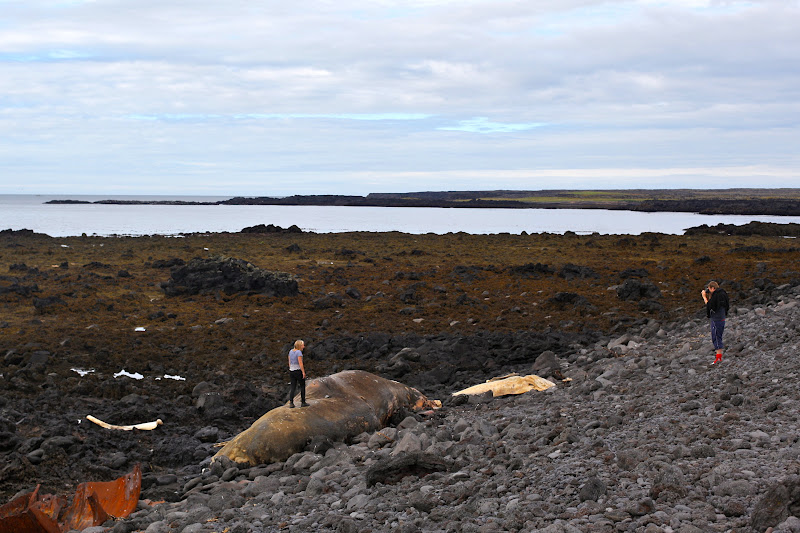
The sign, handpainted and hung low enough that it could have been a child's handiwork, was simple, but baffling. Dead Whale.   Sounds pretty self-explanatory, and if the words had been Fresh Corn or Yard Sale we could have easily taken it at face value.  But the words, again, were DEAD WHALE.  It's the sort of sign that stops you dead (ha!) in your tracks.   In our case, it had us reversing our rental Toyata Yaris after a few seconds of discussion.   "Do you think it really...?" "Is there actually a...?"
We weren't the only ones who followed the lead.  Along a rocky ridge, we saw a family of five and a young couple standing and looking out toward the water. As we moved closer, we noticed that their chins were tucked into their necks.  They were all looking down at something.   Maybe they were looking down at nothing.  The three youngest gazers turned and walked away silently and we took our place up on the viewing platform.
I'm not sure why I was so startled by the enormous lump rising from the rocky shore.  Why I yelped, "Oh my god!" and slapped my hands over my face.  What else was I expecting?   I hadn't really thought it would be a hot dog truck named "Dead Whale" to reel customers in as I'd joked.   (Though Icelanders do love their hot dog trucks).   This is what I was hoping for, what we'd turned off the road to see.  A dead whale it was, plain as day.   A young woman climbed on top of the beached whale while her boyfriend took a picture.   I imagined her hitting a soft spot and falling straight through into the rotting corpse of a giant whale.   Jonah! the horror movie.
The thing is - the waters surrounding Iceland are some of the best for whale watching in the world.  Humpback, minke, fin, sei and blue, they're all regularly sighted around the coast.  So, I arrived in Iceland with anticipation.  Would I get to see a whale?!   I guess that's what made the dead one so jarring.   It was a whale all right, my very first outside of the technicolor captivity of Sea World, but I wasn't really getting to see it any better off than Shamu.  It was still amazing to see the majestic creature, a little smushed but without swarming bugs or snacking seabirds disturbing its rest.  There wasn't even a stench.  More amazing was the fact that we'd found it following a sign put up on the side of the road.  Just another day of driving around Iceland.
You have read this article Animals / Driving / Iceland / Seaside with the title Animals. You can bookmark this page URL https://africathoughts.blogspot.com/2012/08/dead-whale.html. Thanks!
Wednesday, August 22, 2012

A Rotten Bite of Iceland

Icelandic people have a famous delicacy – a vice, some might say – that they hang in little drying houses and eat with pinched noses.  It’s called kæstur hákarl, but is more commonly called just hákarl.  What is it?  Rotten and dried shark meat.  Is it all that bad? Well…
Here, a small family drying house sits by a chilly bay.  The meat inside had crusted on the outside and turned yellow.  It was protected from varmints by chickenwire, but left open to the wind and flies.  It smelled of fish, ammonia and barnyard.  This is a delicacy that’s not exactly delicate.
Hildibrandur Bjarnason (left) and his son, Brynjar Hild Brandsson, are the biggest hákarl producers in Iceland, processing about eighty of the big sharks a year on their remote farm, Bjarnarhöfn.  Hildibrandur is a jolly man who seems to thoroughly enjoy his product and his life.  Besides rotting fish, the men are especially proud of their prize Icelandic horses, which roam semi-free in green pastures by the North Atlantic.  The father and son have the mixed sturdiness of fishermen and farmers; they live solidly and simply.  We were shown pictures of Hildibrandur hoisting one-ton fish with the bucket of his tractor, the earth muddy beneath the wheels, the sea misty behind.
Hildibrandur’s family ferment only the native Greenland shark, a coldwater species that lives further north than any other shark.  The huge fish can grow over twenty feet long, weigh as much as a ton and fish at depths of seven thousand feet. Extreme levels of uric acid and trimethylamine oxide in the flesh act as anti-freeze, allowing the shark to stay alive in water barely above freezing – but also making the meat highly toxic to humans.
A frighteningly easy process has evolved to deal with the problem.  Hákarl is simply left to rot for six to twelve weeks until it’s completely putrefied and (supposedly) ready to consume.  At Bjarnarhöfn farm, they assured us that this was done in the colder months, so that “it never goes bad.”
To get rid of the toxins, medieval Icelanders discovered that they could piece and bury the fish in sand, then let it slowly rot until most of the poison was gone.  Huge rocks were placed over the sand to press out liquid.  After unearthing the huge creatures, to preserve the meat, they let it dry in open-sided barns.  As Brynjar noted, the process was still much the same – “we never use salt,” he said, “no chemicals, no smoke, it is just pure.”  He did say that the rotting process was done in plastic now, instead of sand.  At their drying house, we could smell the sea better than the shark.  Chickens scratched in the high grass, show horses grazed in the meadows nearby.  Everything felt perfectly clean, scoured by the cool ocean breeze.
We were given a tiny taste of the hákarl, accompanied by a nibble of strong rye bread.  The taste wasn’t as extreme as some have made it out to be – it smells intensely of ammonia, but not more so than a piece of too-old cheese.  The texture was softly chewy, there was little nuance.  It’s fishy stuff, but not overpowering.  One little bite was enough, though, and we had no desire to buy ourselves a packet.  Even Hildibrandur and Brynjar admit that Icelanders only eat the stuff on special occasions, and then only in small quantities.  “It’s very healthy,” they said defensively, perhaps misunderstanding the problem.
Greenland shark have become rarer in recent years, mostly due to unintentional killing by commercial trawlers.  Because there’s not much demand for hákarl, and the fish aren’t eaten otherwise, it’s not a seriously threatened fish – but Bjarnarhöfn Farm has still given up fishing itself and relies on bycatch specimens brought to them by larger boats.  In the past, the big sharks were thrown overboard when they were caught in nets, but now they’re sometimes saved to be sold and cured.
By one of the barns, we noticed this shark’s head drying, stretched out over a plastic barrel.  The skin was rough and studded, the little teeth were less frightening than numerous.
There’s a little museum attached to the farm, where the family has displayed their collection of shark artifacts and other island curiosities.  There are fishing lines and harpoons, stuffed puffins and seals, horse yokes and seashells.  Two wooden boats take up most of the room indoors, and one wall is haphazardly arranged with shark teeth and jaws.  There were baby sharks in formaldehyde; because of the intensely cold water, the Greenland shark incubates its hatched young internally, giving birth to a live litter.
Brynjar showed us a dried patch of polar bear fur, two polar bear claws, the skull of a young whale and a very strange fish skeleton – the oddest things they’ve found in shark stomachs over the years.
Bjarnarhöfn is a beautiful place to visit, on a little triangle of green between the water and the rocky mountains, hemmed in on a third side by the Berserkjahraun (Berserkers Lavafield, in English).  Driving in, we had to stop to let a dozen horses cross the lane in front of us.
It's too bad that Iceland's most infamous specialty food is known primarily for being hard to stomach, but visiting Bjarnarhöfn it was hard not to feel a certain fondness for hákarl.  I can't say that I love it, but it is different and romantic in a certain way - Iceland is a tough landscape, with long winters and cold weather.  One can picture the older inhabitants of the farm holed up, slicing thick hunks of shark, growing to love the peculiar taste, waiting for summer and something fresher.
You have read this article Animals / Countryside / Farms / Food / Iceland / Seaside with the title Animals. You can bookmark this page URL https://africathoughts.blogspot.com/2012/08/a-rotten-bite-of-iceland.html. Thanks!
Tuesday, August 14, 2012

CRF: Hungary

"CRF" is not a crime show you've never heard of, it stands for "Cutting Room Floor." Below are some of our favorite pics that never made the blog. We figured we'd reminisce a little while we're home for a visit. (Back in Europe August 20th).
Kalocsa is a small town with a lot going for it. Its claims to fame are varied and fascinating. It is the "paprika capital of Hungary," was the Holy See for one of the country's four archbishops and is the birthplace of some of the most celebrated and iconic Hungarian folk art. So, in one short day trip, we visited a museum dedicated to the national spice, saw the skeleton of Saint Pious all dressed up with no where to go and marveled at the colorful Kalocsa floral patterns at the Károly Viski Museum.
The Hungarian Great Plain or "Puszta" is the land of the cowboy. We went to see the csikósok at work (and play) in a fantastically entertaining and slightly bizarre horse show in Bugac. Here, a donkey sits in the stable mentally preparing for his part in the show alongside the majestic horses. Needless to say, he was the butt of a few jokes.
Just a simple lunch at a simple roadside eatery. Eggs, potato, sausage. Of course, there was paprika involved.
Hungary is a land-locked country with plenty of water. Aside from lakes like Balaton and Baja, there are over one thousand thermal springs that feed into baths and spas, indoor and out. Above, a woman relaxes on flotation noodles in the indoor section of the bath at Lake Hévíz. People had traveled from all over Europe to soak in the curative waters of Hévíz for hours. The pungent smell of sulfur and bobbing swimming capped heads made us think of hard boiling eggs. The regular bathers were no doubt more accustomed to the smell.
Eger was a really lovely city in which we camped for days.  It was our first stop in Hungary and, our first real days of summer in 2011.  We couldn't wait to see everything come to life once again after our long, cold, Slavic winter.  Sure, spring is great, but nothing quite beats green grass, flash showers, children trading backpacks for ice cream cones, overflowing market stands.  Watermelon
A cemetery in Eger. Last names first and plenty of flowers.
We can't remember exactly where we took this picture, but it was most likely in Eger - either from the top of the northernmost Turkish minaret in the world or up in Eger Castle. 
About 20 kilometers south of Kalocsa, we turned off at Hajós. The village has the largest concentration of wine cellars in Europe, around 1300 in just a blip of a town. Out of season (we were there in late June) the pincék were all shuttered. Only the faint smell of fermented grape hinted at the bustle of activity that would once again begin in a few months.
A summer concert in Eger's park draws an excited but demure crowd.
Just a small town corner store we past on our way to the horse show in Bugac. It was a sleepy town in that familiar way, somewhere between one long stretch of flat road and another.
You have read this article Animals / Cemeteries / Cutting Room Floor / Hungary / Museums / Wine with the title Animals. You can bookmark this page URL https://africathoughts.blogspot.com/2012/08/crf-hungary.html. Thanks!
Tuesday, May 15, 2012

Rottweilers And Serbs in Niš

I first saw “f--k Serbia” written on a bathroom wall at a Brooklyn gas station.  It struck me, then, as an odd thing to write, but in Europe it’s a pretty popular bit of scrawl.  I’ve seen it a lot lately, in Croatia and Slovenia and on walls in Macedonia and Albania.  The point is, Serbia isn’t well liked by its neighbors.
In the gathering darkness of a warm evening in Niš we came across a strange, violent dog competition.  Men and women sat in lawn chairs, smoking and talking.  We spent some time marveling at the strange things we happen across.  Traveling – at its best – brings you completely unexpected rituals and cultural spectacles - like this circle in the trees, where people calmly watched Rottweilers attack a man over and over and over.
We aren't in Serbia to judge or rehash history, but 1992 wasn't that long ago.  It's difficult to come to a place like this without questions.  What are Serbs really like?  In general, they've been either incredibly friendly or quite brusque.  They aren't especially crazy about America.  People our age have been wonderfully open and friendly.  In general, they're a lot like most Slavic people.
The dog show was a ritualized display.  One could sense the anticipation of tensed muscles, the quickened panting before the leap, the sharp whines imploring the trainer to loosen the leash.  Attack dogs are strange things, and it takes a particular type of person to want to train them - someone who wants to both control and commit violence.
A young, thin man stood behind a kind of blind with a baton in one hand and a protective tube over the other arm.  When he jumped out and began looking threatening, a dog was supposed to run up to him, bite the arm tube and shake it while being beaten by the baton.  Sometimes, the dogs weren’t quite sure they wanted to attack.  Sometimes they were over-eager, and wouldn’t stop mauling the tube when they were supposed to.  It was frightening the first few times, but we got used to the gnashing teeth and brutish behavior.
Even to uninformed watchers like us, it was obvious which animals were better trained.  They were generally the calmest, and the quickest to loosen their bite when told to.  All of the dogs, though, were admirably non-threatening and well-behaved when they weren't about to attack.  There weren't any fights between the animals, and there was almost no barking.  We felt very safe wandering amongst the wagging tails and lolling tongues.
We feel safe wandering around Serbia, too.  Serbs are good people.  I wish, more than anything, that I wasn't suspicious of them. They don't deserve it.

Apparently, Niš is a Rottweiler hotspot.  Some ten kennels in town are devoted to the breed, and their owners wore t-shirts advertising their services.  Affection between Serbs and Germans hasn’t historically been strong, but the breeders and trainers have names like “Vom Haus Engle” and “Vom Hasen Haus.”  (Also, the hilarious “Rott-Angels from IceBerg.”)  The Deutch bent seemed strange, but there was a clear militaristic, close-cropped-hair aesthetic that isn’t exactly German but emulates a popular idea about Germany. We wondered, watching the show, if some Serbs feel a connection between their country and other old antagonists - a wounded pride, maybe.  Perhaps a desire to be understood for what they are today, rather than what they were.
This kind of dog show happens in other countries, of course.  It's not a specifically Serbian thing, but it resonated with us here in a way that it may not have elsewhere.  It brought to the foreground something that we'd been thinking without wanting to, a question that doesn't quite seem fair - not "who are Serbs?" but "are Serbs the same people that they used to be?"  Rottweilers are very friendly dogs, generally - but they can also be frighteningly vicious.  
You have read this article Animals / Festivals / Serbia with the title Animals. You can bookmark this page URL https://africathoughts.blogspot.com/2012/05/rottweilers-and-serbs-in-nis.html. Thanks!