Thursday, June 7, 2012

Dracula Wuz Here

“We are in Transylvania... and there shall be to you many strange things.” ― Bram Stoker, Dracula

Like any teenager whose melancholy had a gothic slant, I went through a bit of a vampire phase. So, fifteen year old me would have been really excited to arrive in Sighişoara, the birthplace of the real Dracula, Vlad Țepeș. Little Vlad, son of Prince Vlad Dracul ("Dracula" means "son of Dracul"), only lived here for four years. Still, the Dracula Tourism that hit Romania after Vlad was 'discovered' to be Bram Stoker's inspiration in the 1972 book In Search of Dracula, is still reverberating.  When those first foreigners arrived, Bram Stoker's book had never been published in Romanian.  People didn't know what the heck they were talking about! Dracula the vampire?
In Romania, Vlad the Impaler is considered a folk hero not a villain.  His notorious bloodthirstiness was mostly directed at invading Turks. Still, the connection between the fictitious vampire and his historic namesake has been a bit of a cash cow throughout Transylvania.  Tourist attractions that are more fiction than fact.  In Sighişoara, there are indeed plastic fangs and t-shirts that say things like "I Met Dracula Last Night. Come Closer and I'll Whisper the Story in Your Ear."  Even the most relaxed feeling cafe displays "Cafeaua Vampirului " coffee beans for sale.  The bags are cleverly sealed with dripping red wax.  It's all very silly.  More than anything, it feels unnecessary - because Sighişoara happens to be an impossibly pretty town that doesn't need a gimmick. 
Grasping at straws, visiting a bust of Vlad, eating an overpriced meal in his childhood home (completely rebuilt), going to the Torture Museum in hopes of some details about the gruesome methods of the Impaler, the Bram Stoker-reading, Anne Rice obsessed sophomore inside of me was disappointed. But then I realized, at fifteen I had never travelled outside of North America.  The cobbled streets of Greenwich Village, New York made my heart flutter.  I dreamed of backpacking around Europe.  Vampiric let-down or not, Sighişoara would have knocked my socks off
Mission: Dracula called off, I began to really take the place in. In the History Museum, located inside the town's iconic clock tower, the old doors, glass cases filled with button-up satin shoes and fraying top hats evoked that seductive, violent first half of the 2nd millennium.  The Medieval period, when violence pervaded the atmosphere and human contact could easily be the kiss of death. It was the time of the guillotine and the plague.   There was pomp, theatricality, morbidity, beauty.  A yellowed cloth-bound book was opened to a page with ink illustration of a moustachioed man in a three piece suit being stretch and limbered up by pilates-like contraptions.  There were calipers and apothecary bottles.  Instantly, I felt like I was in a world of capes and banquets.  Of vampires.
From the top of the Clock Tower, I looked out over Sighişoara. Transylvania -  Beyond the Forest.  The meaning is obvious and perfect.  It does nothing to take away the mysterious feel inherent in the word.  Transylvania.  The canvas of roofs below zig-zagged in all directions, their skyline climbed up and down frenetically like notes played by a harpsichord. The mountains beyond seemed to stretch for eternity.  There is nothing twee about the region's natural beauty.  The pastel of the houses is replaced by emerald green hills, rust-red rooftops and cobalt blue night skies. Quite simply, it's magical. 
The magic continued in Sibiu, one of Transylvania's most important cities.  Building are animated by unique rooftop windows.  Heavily lidded by shingles they look like eyes watching your every move.  A few nubby stones poke out from smoothly plastered walls.  It is a cheery place, revitalized in 2007 when pronounced the year's European Capital of Culture.  Fresh coats of paint.  Fresh blood.  Wait... are those... bats?!?  False alarm - just birds.  Fanciful trimming on Venetian-style mansions reminded me of lace cuffs and brocade velvet.  That lovely bridge with flower pots hanging from it was named "Liar's Bridge."  That cool old bastion was nicknamed "The Gate of Corpses."  In Transylvania, the whimsy feels a little darker.  The romance, a little cryptic. 
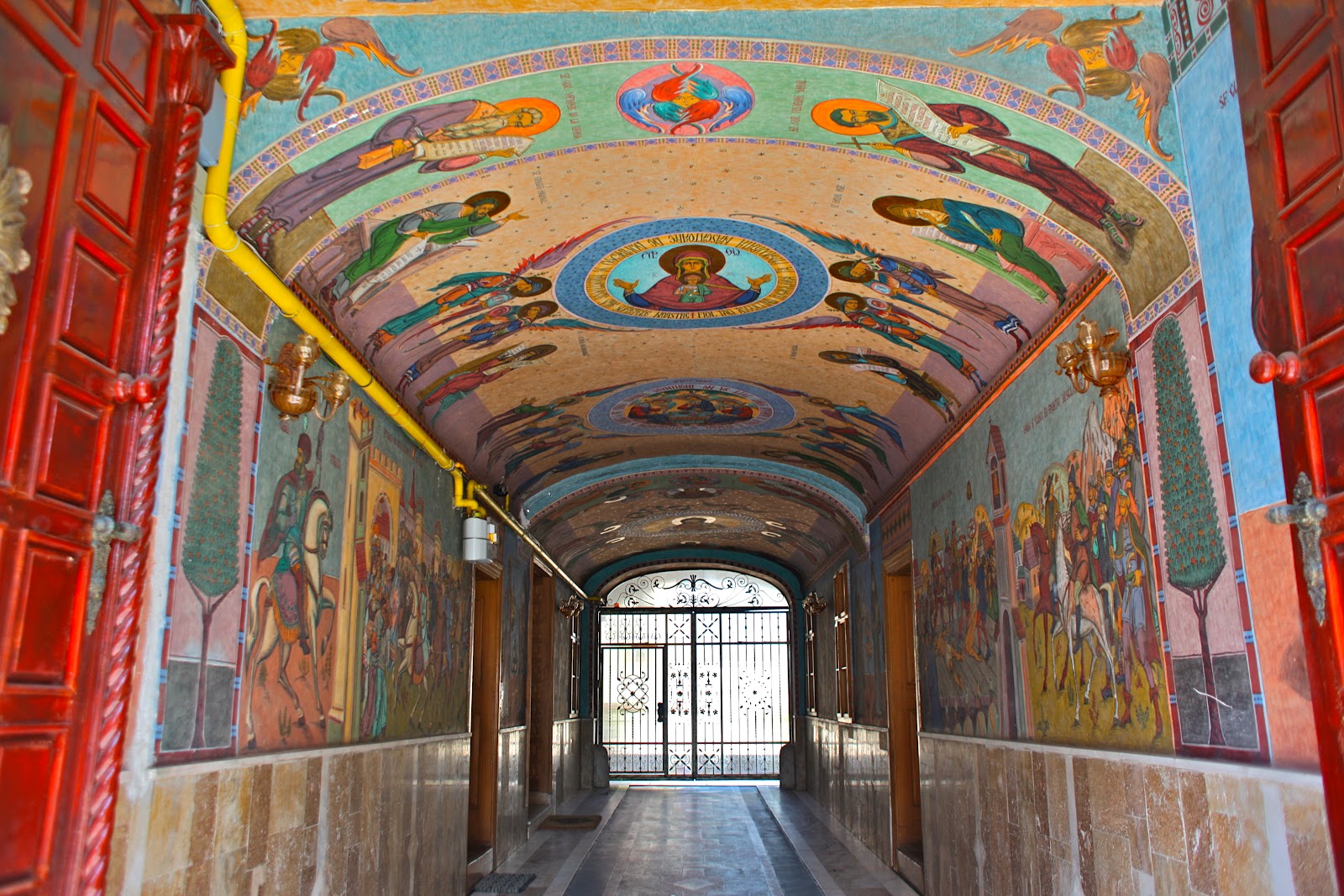
Sibiu is filled with covered alleyways that lead to small courtyards.   Heavy wooden doors close these passages off from the street, from the world.  Across from the Orthodox Cathedral, where black-robed priests moderated a lively debate amongst head-covered women after mass, this walkway shone like a gem.  The ankle-twisting cobbled stones paved in a slant down to one of Sibiu's many squares transitioned, with just a small lip, into smooth, flat, even marble.  Figures were painted on the walls and ceiling.  It was beautiful and, had the doors been closed just a few minutes earlier by a departing priest, hidden away.  It was like the flash of a beguiling smile. 
Oh, fifteen year old Rebecca.  Sibiu was like a storybook you would have devoured cover to cover.  In the Lower Town, below the historic Citadel, buildings decayed.  Plaster chipped and people begged.  Arched walkways gave the streets a gothic frame.  You would have felt the sorrow in it, the eternal sadness and ruthlessness. You would have been so moved by it all, felt so much just looking at it.  Everything you read vampire literature for - a sense of timelessness, savage beauty, shadowy figures and romantic loneliness - was all right here in Transylvania. 
Twenty-six year old me climbed the Council Tower in Sibiu.  Unlike in Sighişoara, the horizon line was there ahead.  The forested Carpathian Mountains were too far away to clearly discern and the buildings of this much larger city stretched out as far as the eye could see.  Below, the International Theatre Festival as going on.  Crowds gathered to watch a circus practice in the main square.  Bram Stoker could not have picked a better setting for his novel.  Who cares if he never actually stepped foot in Romania.
You have read this article Cities / Romania with the title . You can bookmark this page URL https://africathoughts.blogspot.com/2012/06/dracula-wuz-here.html. Thanks!
Wednesday, June 6, 2012

Castle Hunting: Făgăras

Făgăraș is a compact, grey town in a broad valley.  On it’s brisk way across Transylvania, the E-68 gets jostled a little here, at a big roundabout, before resettling on its course.  There’s plenty of traffic, but not many people stop. The old block buildings don’t leave much impression.  From the road, the town’s principle characteristic is blandness, its chief features are the roundabout and the sound of downshifting trucks.
Having coffee one morning, the waitress at the bakery asked me why I had come to Făgăraș.  When I told her that I was interested in the castle she laughed and shrugged, as though it were a novel idea.  She’d grown up in town.  The castle probably seemed more a fact of life than a point of pride.
Actually, the people of Făgăraș should be proud of what they have sitting in their midst.  Just by the E-68 (but hidden behind a ring of trees) is a nice, kept-up, wide-moated castle.  Ringed by water and trees, the castle feels cut off from the cement and asphalt of the outside world.  Swans and paddleboaters make their slow circuits, the brick fortress is small and tidy from the outside, the moat is a perfect reflecting pool.  It feels exactly like so many municipal castles do: something – like a park or a town hall – that fills a small, unpretentious role in public life.
Făgăraș was, traditionally, the residence of the wives of the princes of Transylvania, and was one of the primary fortresses in the kingdom.  It's a strange place to build a castle, on this long plain where there's not much to defend and little natural defensibility.  Originally, there was a 12th century earthen and wooden fort on the site, but this burned sometime in the 13th century.  In 1310, needing to modernize his defenses but lacking readily available hard stone, Prince Ladislaw Kán began work on his new brick fortress.
When we think of a castle, we usually picture it as being made of granite or limestone – blocky, square edged, heavy walled.  But many castles, especially ones built in river valleys and on the plains, were built with bricks.  Often it was just too expensive or time consuming to quarry and haul stone to the site.  Brick also has its architectural benefits – walls could be constructed in more precise curves or with more complex elements than they could with stone.
With the advent of canon warfare, the walls were thickened - actually, a second wall was built within the outer wall and the space between was filled with earth.
The moat had existed since at least the 14th century, but was widened and upgraded when the castle went through a renovation in the 1540’s.  Often, moats weren’t filled with water at all, and served as a kind of ditch that increased the castle’s height advantage – this was partially the case at Făgăraș, where water is thought to have filled the moat in some seasons but not in others.  This changed when a stream was diverted close by and a system was put in place to allow the moat to be filled quickly if needed.  It’s broader than a lot of moats, and also far away from the walls themselves – the fear was that water would damage the foundation of the castle, which hadn’t been built to deal with seepage.
Făgăraș houses a catch-all town museum now, with old looms and icons, prehistoric pottery and communist era stamps.  It’s a nice collection, but feels meager for the big space.  This was intended as a residence and a fortress, and the inner castle has some eighty rooms, many of them quite large.  Not everything is open to the public – far from it – but it’s easy to wander for a half hour or so without getting bored.  Unfortunately, there are no good views of the inner walls, and it’s not permitted to climb any of the towers.
Făgăraș suffers a little from being too well preserved.  There is a good deal of construction being done right now, but it’s mostly touch-up work.  In better condition than most similar structures, the inner keep is almost like new – so of course it’s not all open to the public.  More ruined castles are usually more accessible for climbing and exploring, with little to damage.  Here, the old rooms and towers had been appropriated for historical society offices.  Harumph.
The courtyard was undergoing the most work, and was completely torn apart.  The gatehouse too, which looks very nice in other people’s pictures.  The Italianate arches and many of the grand rooms are the work of the 17th century Prince Gabriel Bethlen.
Looking like a ship (can’t you see the prow and gunnels?) marooned in a tiny pond, Făgăraș was especially picturesque at dawn, when the town hadn’t yet awoken and the water was glass-still.  I kept going back all day, to walk around the trees and take pictures of the walls.  You see, I’d asked for two nights at the hotel… and there was nothing else to do.
The next day I drove out on the E-68, hit the roundabout and continued past the clump of trees where I knew the castle was.  So many people had been curious about me in town.  The only visitors they get are those too worn down by driving to go any further, the kind that are gone in the morning.  There are more dramatic castles in Transylvania, I’m told, and ones with more interesting towns built around them, but I grew to really like Făgăraș.  It’s not very brash, but it’s worth a stop.
You have read this article Castles / History / Romania with the title . You can bookmark this page URL https://africathoughts.blogspot.com/2012/06/castle-hunting-fagaras.html. Thanks!
Monday, June 4, 2012

Securing the Youth Vote

It's election season here in Romania and all local government positions - mayors, councilman, all those other titles that you don't remember or never knew unless one of your friends' parents ran for office - are up for grabs.  In Sighişoara, this means war.  And by war I mean amateur ballroom dancing.
Up in the Citadel, at least two wedding parties were parading around town.  The bride and groom were celebrating their future.  Down below, one man was working hard to secure his own - Iulian Sirbu, Independent candidate for mayor.  Judging by the posters around town, in various states of defacement, he is both the youngest and least liked candidate.  What do you do to win people over and make yourself look old and wise?  Stage a children's talent show of course!
I followed the loud music down to a parking lot turned stage.  The crowd was notably young and two clowns plus one face painter were working their way through the audience.  The nearby ice cream stand was making a killing. Blue berets graced the heads of little children (freebies) and the volunteers (with 'I' buttons on it). 
A co-ed group of performers dressed in red polka dots and mouse accessories (ears, tails, whiskers, padded bellied on the boys) waited in the wings.  A musical trio plinked and plonked away on their keyboard, saxophone and flute.  You could tell who their parents were - the only ones not covering their ears.  Tough crowd, no wonder Iulian was working so hard to please them.
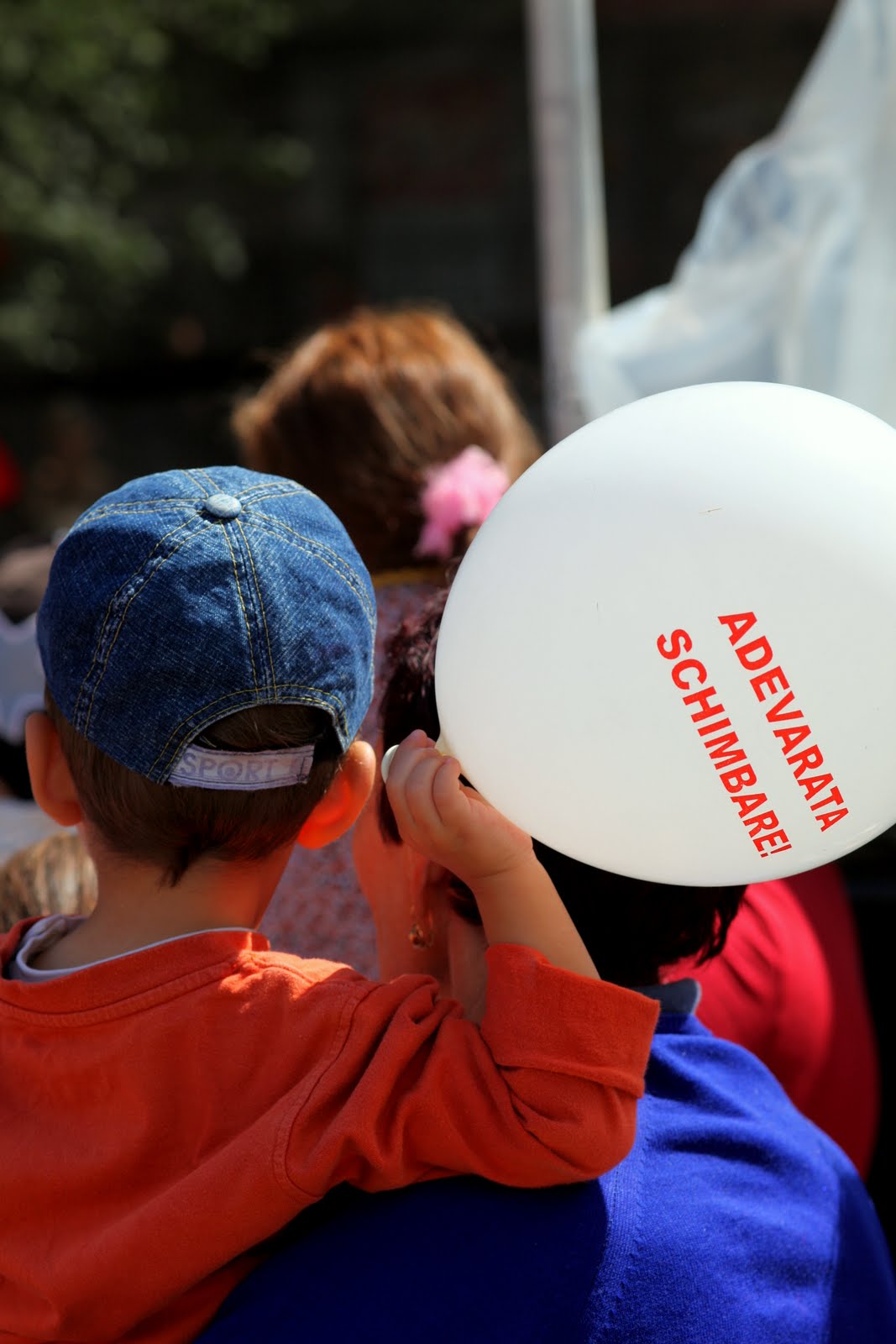
This child is carrying one of the many balloons that read "True Change."  As we were leaving, one of the parents who were attending the performance ripped a poster on their way home.  The poster was Iulian Sirbu's.  It feels heated here.  This is a place where getting the Hungarian vote may lose you the Romanian vote and vice versa.  And then there's the German vote.  Well, better go after the youth vote!
Election day is now less than a week away.  As a woman told me, "the person in office usually stays in office."  In Sighişoara, that means Ioan Dorin Dăneşan will probably prevail.  Iulian Sirbu and the Independent Party have a concert planned for this Wednesday.  Judging by the posters, it'll be playing to an older crowd.
You have read this article Cities / Romania with the title . You can bookmark this page URL https://africathoughts.blogspot.com/2012/06/securing-youth-vote.html. Thanks!

The Wooden Churches of Maramures

Romania's Maramureş county is a land of horses and haystacks, bucolic hills and traditional dress – it’s one of the most untouched corners of Europe.  The region is famed for its wooden churches; old, towering, unique and beautiful, they occupied us for days.
This is the controversial church at Săpânţa Peri monastery, still very much under construction.  Why is it controversial?  Well, it starts with a boast: this is supposedly the tallest wooden structure in Europe, and the townspeople want you to know it.  Standing at over 250 feet (!), it’s certainly a giant.  But the tallest?  In Maramureş, that’s a touchy subject
We arrived at Săpânţa Peri to find picnicking families and a deserted worksite.  Nearby to the church was the shell of a massive, wooden monastic building, shingled roof still unweathered, walls not completely fleshed out, cascades of dormers and rooflines spilling down from a high cupola.  It was a huge structure, but it was still dwarfed by the church, which stuck up above the treeline like a skyscraper.  We wandered through the lower levels of the church, which was open and unfinished, with untidy piles of lumber and beams scattered around.
The church was designed in the traditional style of the region with megalomaniacal plans to be the tallest wooden structure in Europe, which seems like it should make the people of Maramureş proud.  It doesn’t.  The thing is, they already had the tallest wooden building, and it’s not remotely new.
In the tiny town of Şurdeşti, another giant stands much more demurely, hemmed in by leaves and pastoral fields.  Built in 1766, it represents one of the pinnacles of Romanian wooden architecture.  Looking up from the old grave markers and daisies around the base, it doesn’t actually look that tall – but, incredibly, Şurdeşti is only about fifteen feet shorter than Săpânţa’s new church.  Soaring 236 feet (!!), the steeple was, for 250 years, the highest wooden thing on the continent.
And, according to one way of thinking, it still is.
There is a little bell button by the arched gateway to the cemetery for calling the priest – he will sometimes come with the key to let travelers inside.  We pressed the button three or four times, but nobody materialized, which was fine.
What’s endearing about Şurdeşti’s church is how tiny it actually is.  The chapel is not much bigger than the base of the steeple, just a small room and porch designed for a few families to worship in.  Flower boxes and sprigs of pussywillows decorated the exterior, the carvings were simple and unpretentious. This is a church without pomp.  We found ourselves feeling sorry for it, now overtaken by a modern building just miles away.
Not everyone considers the battle of steeples finished, though.  Most people in Maramureş will quickly point out that Săpânţa Peri has an unusual and VERY untraditional (their words) stone base that rises at least enough to disqualify the church from contention.  We sort of agree, though it doesn’t seem as though the Săpânţa Peri base is actually tall enough to be the difference between the two.  Either way, there’s really no comparison.  Şurdeşti is by far our favorite, an old underdog that has charm, character and history on its side.
Maramureş churches aren’t only impressive for their height, though – there’s a wealth of other quirks and beauties among them.
In Budeşti, the old church is nowhere near as tall as some, but it has some of the most amazing paintings.  Many Maramureş chapels are decorated on the inside with icons and murals (unfortunately, most don’t allow photographs inside), but there are few that can match those found at Budeşti.  Painted in two periods – the 1400’s and 1762 - the artwork inside is the reason to visit.
When a village woman - who was probably the priest’s wife, we think she said he was eating lunch -  unlocked the door we were astounded.  Dusky, darkened, biblical scenes literally covered the rough boards of the walls and ceiling, the beams and altar.  The paintings were done in a simple way that suggested a dedicated but untrained hand.  Luckily, we were allowed to photograph the door, which should give you some idea of what was inside.
Budeşti, like many of the wooden churches, was painted as a kind of teaching tool.  The scenes were supposed to help villagers – most of whom were illiterate – learn the stories and lessons of the bible.  This chapel’s most notable paintings were designed, also, to frighten; a whole wall near the door was dedicated to scenes of hell.  Many of the tiny images involved naked sinners being sodomized by devils using nails, pitchforks and bellows to terrifying effect.  It was startling, but also a little humorous (very imaginative).
In Ieud, where we stayed with a welcoming family in a house that overlooked meadows and forest, the oldest of all the Maramureş wooden churches sits on a hill by the river.  Dating from 1364 (and reshingled every several decades since) the church is one of the older all-wood buildings still in use in the world.  Sitting among ancient graves on the site of an even earlier, ruined castle, the fir wood building has survived six and a half centuries of rough winters, invasions, and weekly use.  Intriguingly, the oldest printed volume in the Romanian language was found in the attic some time ago, though it’s now housed in a museum.
Iued’s other, more central church was “only” built in 1717, but was similarly given UNESCO world heritage status for its huge collection of icons painted on glass.  We couldn’t track down the priest, so we never made it inside – but we could see the steeple from our bedroom window.
You have read this article Architecture / Countryside / History / Religion / Romania with the title . You can bookmark this page URL https://africathoughts.blogspot.com/2012/06/the-wooden-churches-of-maramures.html. Thanks!
Saturday, June 2, 2012

Full Steam Ahead!

The engineer puffed on a cigarette while he waited for us to embark.  Elvetia, the 1954 Romanian built locomotive he was perched in, puffed along with him.  Heavy mists were slowly lifting from the Carpathians and the lightened clouds, having shed a good amount of rain the night before, were moving across the sky.  It was 8:30 in the morning and we'd maneuvered around potholes and horse-carts to make our train - one of the last wood-fired, steam-powered trains in Europe.  You could smell the lumber in the smoke, its brown bark adding sweetness like the burnt caramel on crème brûlée. The smell reminded Merlin of sugaring in Vermont.  At 9am, with the shrill whistle of a gargantuan teapot, we were called on board.
The CFF Vișeu de Sus, also called The Carpathian Forest Steam Train, is referred to simply as "mocăniţă" by locals and the signs they have posted along the road. It's a derivation of the Romanian word "mocan," which means shepherd or mountain dweller. The mocăniţă which begins its journey in Vișeu de Sus snakes its way up into the Carpathian Mountains to collect timbre and shepherd it back down to the village. Its narrow gauge track follows the Vasar River toward the Ukrainian border, up into the Vasar Valley. The valley is unique to the Carpathians in its lack of habitation - well, human inhabitants at least. Deer, bears, sheep, abound. And those quickly proliferating beasts known as 'tourists.' 
Okay, now's the time to say it. This was a tourist ride, as are all of the wood-fired, steam-powered trains that leave this and any other station in Europe.  They are such rarities that it only makes sense to utilize them in this way - to offer a technicolor experience to people's sepia toned dreams of old-timey travel.  A Swiss nonprofit helped turn this railway into an attraction, to preserve the track, the trains and offer aid to the community around it in an ingenious way.  Merlin and I talk about foreign aid like this a lot, likening it to buying someone a cow instead of giving them milk money.  The 'cow,' being tourism.  Because of this, we assumed the "CFF" on the side of our train referenced the Swiss Federal Railways.  It actually stands for Calea Ferată Forestieră, "forestry railway" in Romanian.
In most of the world, roadways began to push locomotives out of business in the 1950s and 60s.  Romania isn't most of the world, though, and steam locomotives were still being built as late as 1986.  Along our way, we saw two of these re-jiggered vans moving right along next to us.  For loggers and livers in this neck of the woods, the train track is still the only access route.  We'd actually seen one of these on our first day in the country, crossing from near the Serbian border to Cluj Napoca.  What a crazy thing to see sidle up next to your passenger window.  On that modern diesel-powered bullet of a train, the van putted alongside and then fell back into the distance.  During this ride, it smoothly moved forward beyond us. 
At least two people are needed to run a steam locomotive.  Ours was staffed with five.  You had the engineer, the boilerman and a third fellow who swapped places with both of the others.  In addition, two young women acted as conductor and kitchen car cook.  One donned a lop-sided cap when collecting tickets, the other was in charge of grilling hot dogs at our lunch break.  They chatted the whole time, along for the joyride.  The other three had no choice but to run this thing like they always would, whether it was just doing a loop with some foreigners with cameras on board or not.  That's the amazing thing about this ride, to actually feel the mechanics of this bad boy.  To feel it jut and spurt, to watch them feed logs into the boiler and gather water from the river to replenish the locomotive tanks.  It's like watching men re-cobble a street - outmoded skill sets that become lost arts.
The Vaser Valley has had economic significance since the 1700s, when it was still a part of the Austrian-Hungarian Empire.  When the railway was built at the beginning of the 1930s, German speakers and Romanian Jews were running the show.  They would cut down trees up in the heavily forested mountains and then send them down to saw mills in Vișeu de Sus.  The two World Wars affected both ethnic groups in some really dire ways and the lumber industry diminished - almost vanished.  Even with modern transport, the area is not the cash cow that it was in its heyday.  It was amazing to see the loggers' settlements along the river.  In just under three hours, I think we saw four.  The bridges made us gasp - two long logs strapped together with a railing.  Don't be fooled, it was actually just one log, until it bent toward the water. 
At the start of our journey, we passed more houses.  At each one, someone stood outside to watch us go by.  We waved, they waved back.  I wondered how many of the very old ones had watched the first wave of trains pass by.  How amazing they must have seemed.  How amazing they still are.  The Maramureş region is still a part of the world that remains mostly car-less.  Houses do not have driveways, horse-drawn wagons are the norm.  It only makes sense that these locomotives would draw a crowd.  Especially with a bunch of foreigners on board.  A German couple who were so intent on picture taking that they reminded me of that video of Britney Spears attacking a car with an umbrella (yes, I've seen it. so what?)  Cultural paparazzi these two were.  For all our grumbling, they elicited smiles and waves from everyone we past.  Their photos were probably amazing.
Diesel trains that run along this same track do most of the dirty work these days, leaving these antiques for lighter loads. We saw weighed down carts awaiting pick-up and the trains that retrieve them sliding down the track on neutral.  This is how this line was designed, allowing small trains to move upward at a steep enough pace that their return trip (with looooaads of wood now attached) would be aided by gravity.  Our own train picked up small delivery of its own - all tourist rides are still working trips for the local logging industry.  If no one shows up, they still go up to get the logs that are waiting.  We wondered how our train was going to turn around to go back in the direction from which we came.  It simply didn't.  The main cab disattached, moved back and around and joined back up with our cars on the other side.  The conductor navigated our way back in reverse.
We may not have needed to be on the train for four-odd hours to get the point.  Sure, I may have begun to think of The Kinks' song "Last of the Steam-Powered Trains."  And I don't know where I'm going/Or why I came.  I wasn't the only passenger that napped.  But don't they say it's all about the journey and not the destination?  Isn't that basically what our lives right now are all about?  It was amazing to have done it, especially in Maramureş County, where boarding a steam locomotive didn't feel all that unusual and it being anything other than wood-fired would have been bizarre. They use wood for absolutely everything here. As I'm sure we'll explore in greater detail really soon. 
You have read this article Countryside / Romania / Trains with the title . You can bookmark this page URL https://africathoughts.blogspot.com/2012/06/full-steam-ahead.html. Thanks!

The Sârbi Țuică Still

Just off the pothole-riddled road in the center of the little hamlet of Sârbi, under a ramshackle wooden roof next to a stream, we found this old woman turning a crank slowly, her eyes glazed over, her mouth set in a slight smile.  She was making ţuică, a traditional plum brandy that Romanians can’t exist without.
Ţuică is firewater, moonshine - a 100 proof, scald-the-tongue tradition that isn’t exactly legal but is still the national drink.  Accompanied by the rushing burble of the water beside her, the woman seemed an unlikely outlaw distiller, but there she was.
We took a small detour to Sârbi because there's an interesting brook laundry whirlpool there - a kind of sluice-fed, foaming vortex of rotting boards where the village women wash their rugs and other sturdy cloth.  Nobody was doing their washing, but there was a group of people tasting and buying ţuică.  In the same complex was a sawmill and fulling mill, plus a turn-off in the road where men stood around and watched the passing traffic (which consisted of at least as many horse carts as cars).
The cooling bath was fed with a pipe that ran directly from the stream, and was hung with the cups and buckets of the tasters.
The still was hand-pounded copper, with a long, swan-necked top that looked particularly unstable.  A woodfire was hissing in the brick beneath the still, the crank turned a scraper that kept the mash from sticking.  An enameled bucket caught the intermittent spurts of alcohol that emerged from a low spigot. With one's nose close to the collected, clear ţuică, the effect was eye watering - the fumes were enough to get drunk on.
Ţuică is served before every respectable dinner in Romania, usually just a small amount in a shot glass to clear the palate and prime the stomach.  The man who was giving tastes of ţuică seemed – because of his ruddiness, tilt and excitement  – to be a lifelong connoisseur.  A few bottles of differently aged liquids sat on a table with a plate of bread.  Everyone partook, including our host.
The mash sat uncovered in plastic barrels, smelling strongly under the midday sun.  It was not, as one might say in America, “safely stored,” but it doesn’t matter; any bacteria will get killed in the still.
Plums are the most commonly grown fruit tree in Romania, and are used almost exclusively for making brandy.  As with 19th century American apples, the breeds aren’t developed for eating, but instead for their fermenting properties.  The "Prun Tuleu gras" is the king of Romanian plums, but isn't much by itself - the flesh is very firm and apple like, it doesn't have the liquidity that Americans are used to. Every country house has at least one tree.
Operations like the one in Sârbi aren’t entirely legal, but they’re tolerated.  Traditions run strong in Romania, and the thought of enforcing the ban on home distillation is particularly loathsome to peasant communities who couldn’t afford store bought liquors or the permits needed to make their alcohol comply with the law.  The effect of the ban is limited - ţuică is sold everywhere, in plain sight, on roadsides and in little stores, often in repurposed wine or soda bottles.  But the majority of the stuff is made at home or at a communal still for a family’s own use – it would be impossible and mean to enforce the ban.
At our homestay in Ieud, we were presented with a bottle of the host’s own ţuică every night before dinner.  We had a few tiny glasses, then let it be.  The bottle had been reused a number of times, the threads of the cap had worn out.  The family had grown a pear inside the glass themselves, which initially caused some confusion.  Eventually we got it straightened out; the pear was for flavoring (minimal) and decoration (very pretty), the alcohol was one hundred percent plum.
Perhaps worried about our taste (or tolerance) for the stuff, our host mother also brought out a bottle of cherry liquor and a precious decanter of black-currant alcohol, deep purple, that she wanted Rebecca especially to try.  It was all very tasty, but the ţuică was our favorite - it considerably loosened up the table conversation.
You have read this article Countryside / Drinking / Romania with the title . You can bookmark this page URL https://africathoughts.blogspot.com/2012/06/the-sarbi-tuica-still.html. Thanks!
Friday, June 1, 2012

A Prison Worth Entering

In the decade between 1945 and 1955, around 200 people were incarcerated at the prison of Sighetu Marmației. Bishops, priests, historians, artists, military men, professors, intellectuals, anyone who 'threatened' the stronghold of the totalitarian communist system of Romania. Most inmates were over the age of 60 and were never even tried for a specific crime.  Today, converted into the Sighet Memorial Museum, it holds more men and women than it ever has before - thousands of Romanians and millions of international victims of communism in the 20th century. The museum is the work of the International Center for Studies Into Communism who tirelessly unearth and enlighten as much about this period of history as possible. 
There are signs all across the region of Maramures advertising the museum.  "Have You Visited?" it asks above a photo of these statues, 'the convey of martyrs' - 18 naked men and women in varying displays of agony.  Their view of the horizon has been blocked by a wall, a symbol of communism's effect on the human spirit. The photo makes the poster's question seem threatening. "Why haven't you visited yet?" While it may not be the best marketing strategy, it is in line with the museum's mission to stress the importance of remembrance. To educate young people and re-educate older ones "who for half of a century have been misled with false history."
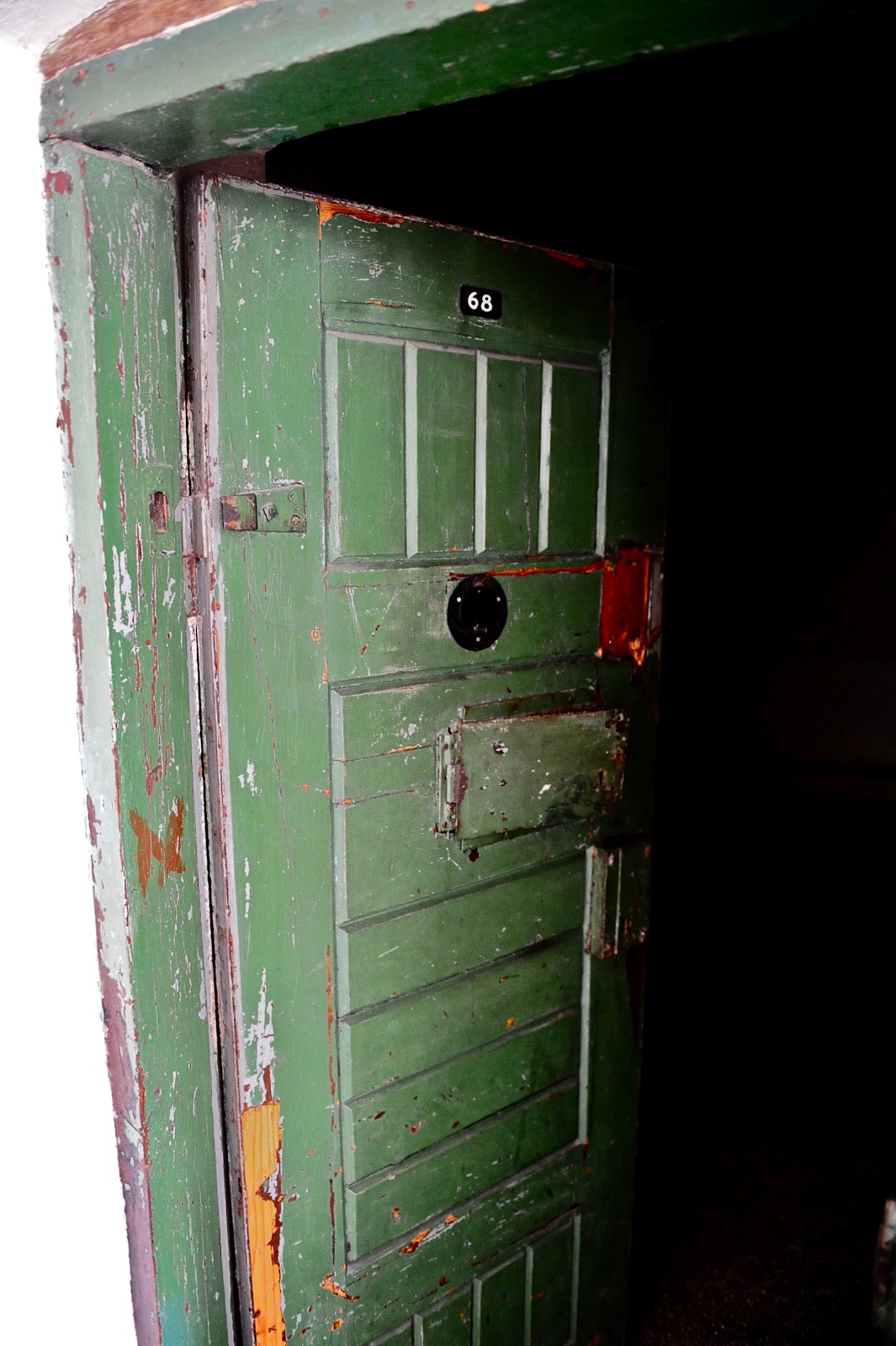
It is a beautifully curated museum.  You can tell, instantly, that there is a passionate group of researchers behind the project.  Upon entering, we were handed an information packet to bring around with us.  This was not simply a translation of the exhibits' text, it was a history, a mission statement and a story.  Honestly, it was difficult to remember to look up and around myself, my nose buried in the engrossing material.  How they dealt with the space was equally impactful - keeping a few cells exactly as they looked during the worst years of the prison.  Because so many of the cells were plastered with research, timelines, photos, records, you really felt the isolation of these sparse rooms.  The truth and the story inherent in this space didn't need to be spelled out.
The prison was once a veritable filing cabinet of human lives. Earmarked in society, they were sorted and shuffled and slammed closed behind metal doors. Inside the cells, these lives jumped out from the walls. But once you were back in the hallways, it was like a closed cabinet once more. With fencing draped across almost every empty space and natural light shining in like a sick tease, you thought only of the prison itself. Its coldness. Even a large group of young school children couldn't lighten up the atmosphere - braided pigtails, pink sweatsuits and all.  
The amount of information, evidence and personal items in the museum was staggering.  Many of the rooms reminded me of the hours my brother spent in front of the microfilm machine in our public library.  He was working on a 7th grade term paper about the Holocaust.  I looked over his shoulder.  Photos, clippings, records, files. Most of the data-heavy rooms would include something sensory as well.  Faint tapping could be heard in the cell dedicated to prison poetry, which was shared cell to cell through Morse code.  A room about the redistribution and confiscation of family-owned farms had a large box of brilliantly green sod at its center and this cell - focused on work camps - displayed one of the many fruits of the prisoners' labor, a motorcycle.
It's sort of surprising to think that the full truth of this period in Romania's history wouldn't be more widely known and accepted by this points. This isn't Albania, where the dictator whose thumb the country was under for decades was also instrumental in cutting them loose from Nazi Germany, and then Soviet Russia. Neither is it Serbia, where a number of people we spoke to fondly remembered certain elements of Tito's regime.  If you can rate such things, Nicolae Ceauşescu's rule over Romania is considered one of the most oppressive and ruthless of the Eastern Bloc.  The term "most Stalinist" is thrown around - and there's no way that adjective could mean anything good. And, yet, this sort of memorial is necessary. There's a reason Ceauşescu cherry-picked his 'historians' and threw the rest in this prison. There's a reason it's still difficult to get the people who were there to feel safe speaking freely. 
The International Center for Studies into Communism has, in a little under a decade, recorded over 5,000 hours of eye-witness accounts, compiled tens of thousands of documents and published books that add up to almost 40,000 pages. Not to mention creating this wonderful museum. They say that it is all to "resuscitate the collective memory" and to rob the communists of one of their greatest victories, blinding and brainwashing whole nations. The information packet we were given at the museum ended with this proclamation:  
“Can memory be relearned?” the answer of the Memorial to the Victims of Communism and to the Resistance in Romania is a resounding “Yes”. 
I sure hope so.
You have read this article History / Museums / Romania with the title . You can bookmark this page URL https://africathoughts.blogspot.com/2012/06/a-prison-worth-entering.html. Thanks!