Sunday, January 12, 2014

CRF: The Best of Slovenia

"CRF" is not a crime show you've never heard of, it stands for "Cutting Room Floor." It's been more than a year since we returned from Europe, and we've started to get seriously nostalgic.  To give us all an extra travel fix, we're posting some of our favorite photos that never made it onto the blog.  Here are our favorite unpublished memories and pictures of Slovenia - truly one of our favorite countries.
Slovenia held a special place in our heart years before this trip and we were a little worried about tarnishing it.  You see,  it was the first "weird" place we had ever travelled together.  Our former trips included the post-collegiate trifecta of France, India and Amsterdam.  One of us had read an article about Slovenia in a magazine and the idea of the place stuck (along with Lake Baikal in Siberia, which seemed a little less doable).  We went, in 2006, without knowing how to pronounce the name of its capital and came back its biggest ambassadors, dubbing it "The Vermont of Europe" and encouraging everyone we knew to visit.
It was both more "European" than we'd expected (what does that word mean anyway?) and quirkier than we could have imagined (a doormouse museum?).  It felt like a discovery, a magical place.  One day we were driving through foliage that could rival New England, the next we were eating shellfish on a blip of Mediterranean coast.  There were gorges and caves, castleshorse burgers.  Our farm stay had a pet bear, the capital had parking spots dedicated to electric cars ("way back" in 2006) and a Sunday flea market that finally served up that slice of Slav we were expecting.  Revisiting the country, after traveling to places even further afield, we worried it would feel…. predictable.  Or, dare I say, average.  And then, this happened...
The water caves of Križna Jama are special.  They really are.  They are that solitary, unknowable, ancient thing that lurks at the edges of human existence.  There are human remains in the entryway that date back ten millennia.  One travels for hours by headlight, in blowup rafts, past the oldest of earth's rocky bones.  There are creatures there, in those depths, that exist literally nowhere else in the universe.  No more than eight people a day are allowed in.  All of this, accessed through a rock in the deep Slovenian forest.  By some wonderful twist of fate, our guide was a photographer himself and the photos he prompted us to take are some of our favorites of the trip, inextricably linked to the memory of snapping them.
When we're asked that inevitable question - "what country did you like best?" - we have no idea what to say.  Phrased: "what was the most memorable experience you had?" the answer would be easier.  Križna Jama is the experience we call up when we mean "unbelievable."
The Slovenian karst is full of caves - there's the theme-park-like Postojnska jama and the outlandish cave-castle of Grad Predjama, with hundreds of other caverns in between - but there is none to match the grandeur of Škocjanske jame.  We've been twice, but photos aren't allowed in the main caverns, so we never blogged about it.  This is a picture of the exit, which actually feels small at the end of the tour.  Notice the full-grown trees being dwarfed by the archway.
The main cavern in Škocjanske jame is so large that standing inside, with the lights off, feels like standing outside on a dark night.  You can hear a river flowing, a hundred feet below the walkway.  You feel damp cave-breezes and gusts.  It's the largest enclosed space you can imagine.  A friend brought along on our second visit was nervous.  "I'm claustrophobic," she explained, logically reasoning that this would make spelunking unpleasant.  Škocjanske jame conjures the exact opposite feeling.  All you feel is the expanse, your own smallness.  You feel anything but trapped.  You feel like you're on the edge of something that is somehow even bigger.  
At the very top of Rogla Ski Resort, in the Zreče region, we came across this funny group of schoolchildren filing onto a down-slope chairlift.  Even though it was midsummer, it was cold and blustery in the Julian Alps.
We had hiked up from the endearing, bizarre deer farm that we were staying at, Tourist Farm Arbajter.  Our hosts cooked us venison dinners and gave us homemade borovnica (blueberry schnapps).  We loved it there and promised to return with our family one day.
Slovenia's glamor spot is lake Bled.  It's the Slovenian stuff of postcards.  The rolley-bags outnumber backpacks and footwear gets noticeably less clunky.  It's easy to see how one could be content dropping in on Bled and being whisked back away without ever setting foot in the more rugged landscape surrounding it.  Retirees rent rowboats by the hour.  Young, fashionable people sunbathe on the grassy shores.
Slovenia is very much a tale of two lakes, Bled and Bohinj.  Both are beautiful, but we actually prefer Bohinj, nearby, which has zero luxury hotels.
At some point in our trip, we began taking photos of local candy.  It's the little things.  These were a cross between Necco wafers and hole-less life savers.  We just liked the packaging, really.
We considered doing a post about the unusual and emblematic Slovenian roofed hayracks (called toplarji), but never got all the pictures we wanted.  Here's an old toplar surrounded by modern digging equipment.  It's not easy to find prime examples of the old Slovene way of life, because the country doesn't dwell on its past.  History in Slovenia has been relegated to the national parks, culinary tradition, a few quaint castles and their excellent museums.  Everyone looks forward.
Despite its diminutive size, Ljubljana (pronounced "loob-lee-yah-na") easily feels the most modern of the former Yugoslavian capitals.  It's demeanor mirrors the national spirit: lighthearted, friendly, unpretentious.
Slovenia was the first republic to gain independence from post-Tito Yugoslavia, and there wasn't much violence during the breakaway.  Compared to Bosnia, Kosovo, Serbia or even Croatia, the country has few scars and better memories.
We love this red picture of a tiny, communist-era Zastava (nicknamed "Fičo" in Slovenia and "Fikjo" in Macedonia, where we posted about them) against a high-tech construction site. About a block from here, we saw a tractor pulling bales of hay through downtown Ljubljana.
Like Slovenian food, Slovenian wine is pretty basic.  It's also cheap, tasty and plentiful.  For a while, we were working on a vini-post that didn't get finished.  It was going to be about the vineyards of the Vipava and Štájerska regions, but we never got the cornerstone picture or experience that a good piece needs.  It was still fun to try.
We took this picture at a  courtyard "vinotok" in the colorful wine town of Slovenska Konjice. Underripe grapes hung from an arbor over our heads.  If it had been September instead of July, we probably would have had a great, boozy post.
We're still crazy about Slovenia.  Comparing it objectively to its neighbors, it might seem a little boring.  It has nothing to rival the history and cuisine of Italy.  It's mountains aren't as impressive as Austria's.  Ljubljana doesn't hold a candle to Hungary's Budapest, and it's tiny bit of coast is barely a blip next to Croatia's sprawling seafront.
But Slovenia has a bit of everything, and also possesses maybe the most pleasant vibe of any European country.  It's always at the top of our list of recommendations - especially because of all those caves
To see all our posts from Slovenia, just click here.
To see all the Cutting Room Floor posts, with great pictures from the other 49 countries, just click here.
You have read this article caves / Cities / Countryside / Cutting Room Floor / Lakes / Skiing / Slovenia / Statues / Wine with the title . You can bookmark this page URL https://africathoughts.blogspot.com/2014/01/crf-best-of-slovenia.html. Thanks!
Tuesday, January 7, 2014

Kloof - a leafy suburb of Durban

The small town of Kloof is a suburb located on the greater Durban area in KwaZulu-Natal. Kloof translates from Afrikaans to mean Gorge and is named after the deep gorge that has been formed from the Molweni River. The Kloof Gorge forms part of the Krantzkloof Nature Reserve which extends for approximately 5 square kilometres. The middle to upper class suburb of Kloof borders onto Winston Park, Forest Hills, Gillitts and Hillcrest which together are known as the Upper Highway Area. The area is also known as a mist-belt and includes winding roads and lovely mansions surrounded by trees. There are a number of shopping malls in the area such as Maytime Shopping Centre, the Village Mall, Fields Shopping Centre and Delcairn Centre. There is a lovely selection of places to stay in Kloof from Guest Houses, Bed and Breakfast and self catering accommodation.

Kloof Country Club is located in the green hills of Kloof, within easy access of Durban, and combines a wide choice of activites from the wonderful 18 hole Golf Course, to a squash centre, dining and conference facilities, tennis courts, swimming pool and also a cricket pitch. The Golf Course has been designed to USGA standards and offers a challenging course with a well earned refreshment break available at the Halfway House.

The Krantzkloof Nature Reserve is approximately 532 hectares in size and is managed by Ezemvelo KZN Wildlife. Although you will not see the Big 5 here you will discover zebra, grey duiker, vervet monkey, bushbuck, mongoose, genets, rock hyrax and many other animals. The birdlife here is excellent with over 200 different variety of birds being recorded. Much of the reserve is covered by thick forest and vegitation and has superb views across the gorge that has been created by the Molweni River.

Click here for more ideas on where to stay in Durban.
You have read this article accommodation / durban / explore south africa / golf / kloof / kwazulu-natal / where to stay with the title . You can bookmark this page URL https://africathoughts.blogspot.com/2014/01/kloof-leafy-suburb-of-durban.html. Thanks!
Thursday, January 2, 2014

Top 03 Driving Tips for South Africa

1. Always fill up your car with petrol before embarking on a long journey. Distances between Petrol Stations can vary quite a lot and with such big distances between towns and cities it is better to be safe than sorry.

2. Try to plan your journey for day time driving. Driving at night can be hazardous especially out of the towns and cities. It is not uncommon to come across cows, monkeys and goats wandering across the road and at night there are many stories of cars hitting these animals. Also roads outside of town are not well lit if at all.

3. When stopping at a petrol station take advantage of the attendants and ensure they clean your windscreens - for the sake of a R2 tip it is well worth it.

4. Try to tune into a local radio station when travelling - they are normally very good at warning you of roadworks and those aptly named "smile zones" - to you and me these are speed traps !

5. For those long journeys make sure you take some food and drink with you in the car. Great for keeping the kids quiet when they start getting bored.

6. Keep a camera handy with you in the car - you just never know when you are going to come across wonderful scenery, animals or interesting sights.

7. Make sure you have your driving licence with you always. If you are stopped by the police they will want to see this. It is also always worth keeping some cash handy for those annoying on the spot fines.

8. Be aware that some of the roads in South Africa are not up to the standard of those you may normally be used to. If you are driving off the main roads or around areas like the Wild Coast you will really need a 4X4. You wouldnt want to miss out on some of the more off the beaten track sights beacuse your car isnt up to it.

9. Make sure your mobile phone is charged and you notify people of where you are going and what time you should be reaching your destination. That way if you are late you are contactable or can contact someone if you break down.

03.When parking your car anywhere do not leave valuables on show. Like anywhere in the world there are petty crime theives that are only too willing to snatch them.
You have read this article driving in south africa / driving tips / South Africa / south africa travel with the title . You can bookmark this page URL https://africathoughts.blogspot.com/2014/01/top-03-driving-tips-for-south-africa.html. Thanks!
Wednesday, January 1, 2014

Weekend away at Oceana Beach & Wildlife Reserve - Port Alfred

This weekend we spent a night at Oceana Beach and Wildlife Reserve which is located just 5 minutes outside of Port Alfred on the Eastern Cape Sunshine Coast. Oceana is situated in an elevated position overlooking 7km of private beachfront in the maleria-free Eastern Cape. It opened its doors for business approximately
4 years ago and has established itself as a 5 Star Game Reserve and Spa Retreat.

The location is extremely private and has a really romatic feel about it. The main lodge has a lovely bar with seating around a log fire and separate dining rooms. It would make an ideal setting for a wedding function or to just getaway and pamper yourself for a few days. We arrived early evening and enjoyed some pre-dinner drinks on the patio overlooking the Indian Ocean whilst gazing at the amazing star-filled sky.

As we were celebrating a special occasion our hosts had organised us a private table for 2 in one of their lounges with a lovely fire going next to us. The food was of a very high standard and the service was excellent. After dinner we enjoyed our superb cappuccinos by the open log fire by the bar. Next to the bar area there is a very nice patio with steps leading up to the swimming pool and boma. If you are having your wedding here then Oceana have a large Bedouin-style tent that covers this area and makes for a wonderful setting.


That evening we stayed in a lovely chalet with large balcony overlooking the Reserve and Indian Ocean. Our room had a wonderful double bed with TV at the end of it. There was also a his'n'hers bathrooms with a bath with views outside in one of them. The rooms are extremely well appointed and very spacious.

In the morning we sat outside with our coffee and watch the sunrise and the animals roam around just a short distance away. Oceana is not a Big 5 Game Reserve but it still has Giraffe, Rhino, Zebra, Buffalo, Wildebeest and many other animals. There is a lovely fitness room near the Lodge with magnificent views plus an excellent Spa with a range of treatments available. Other activities on offer at Oceana include; Surf and Rock Fishing, Game Drives, Bush Picnic and Sundowners, 5 hole putting green on the Heli Pad, Steam Room and Games Room.

Visit Where2Stay-SouthAfrica for more South Africa Accommodation ideas. 
You have read this article accommodation / beach holiday / eastern cape / game reserves / oceana / Port Alfred / South Africa / south africa travel / spa retreat with the title . You can bookmark this page URL https://africathoughts.blogspot.com/2014/01/weekend-away-at-oceana-beach-wildlife.html. Thanks!
Friday, December 20, 2013

CRF: The Best Of Slovakia

"CRF" is not a crime show you've never heard of, it stands for "Cutting Room Floor." It's been almost a year since we returned from Europe, and we've started to get seriously nostalgic.  To give us all an extra travel fix, we're posting some of our favorite photos that never made it onto the blog.  Here are our favorite unpublished memories and pictures of Slovakia.
There are lots of Slovak trucks on the roads of Europe, and it's well known as the "other half" of Czechoslovakia, but it's still a little-known, hidden away country.  Crossing from the Czech Republic, we descended into a rougher land, spiked with tall pines and criss-crossed with big rivers - Slovakia smells first of wet woods and coarse paprika.
But there are also elegant promenades and beautiful towns, great museums and copper steeples.  One of our favorite towns was our last, the charming Banská Štiavnica in the south-west of the country.  This intriguing "plague tower" shone brightly in the middle of Trojičné námestie square.
At the technical museum, in Košice, we got lost in the dark, wonderful rooms.  Outside, the city was full of music and weddings, but the world contained in those dusty hallways was a silent one.  Displays of prickling antennae, bare wires, worn typewriter keys, dull lenses, remote controls - and what seemed like a hundred gramophone speakers.
Slovakia was a prickle of peaks and forests in the western part of the country.  At first, as we climbed in from the Czech Republic, the whole landscape was made of wood and stone.  It was wild.  We passed a shepherd once, standing in the mist by his flock, who wore brown robes of sheepskin that reached all the way to the ground.  He stared at us in the alpine cloud, leaning on his crook.  At that moment, Slovakia felt like part of the untamed past.
On the other hand, the middle of the country is flat and hot.  The land there is a continuation of the great Hungarian puszta, and the roads stretch out simple, flat and dusty.  We ate oil-slicked, paprika chicken soup at this restaurant, in the heart of the plain.  A thin, aproned Roma woman served us.  Across the road, a shanty village glowered.  Kids kicked at trash, the streets were full of brown water.  We stopped for not much more than an hour. The food was delicious and hearty, as it tended to be in Slovakia.
At "Theatur" bar, in Košice (not the gambling den pictured here), we had a long discussion about martinis.  Mainly, we talked about how good Theatur's martinis were - the young, blond bartender shrugged when we complimented her work.  "I didn't even try," she said. We agreed, after much discussion, that they were the best drinks we'd had in months, and were probably the best to be found within two hundred miles.
Košice is full of good food and exciting things.  It's also has - like so many regional hubs in ex-communist backwaters - its share of red neon and bleak-faced vagrants.
When we stayed in the forested hamlet of Podlesok, there wasn't much light at night save for the moon and stars.   In Slovenský Raj Národný Park (home to the slippery, scary Suchá Belá waterfall course) we saw men logging with horses and clearing weeds with scythes.  This was the edge of modernity, where tradition and machinery were meeting each other in the forest.
Ovčí syr (Slovak sheep cheese) can be so dry and thready that it almost feels like fiber on the tongue.  The tendrils squeak in your teeth. The texture is both bouncy and melting. Forget bryndzové halušky, this is Slovakia's real national flavor.
(Actually, bryndzové halušky is just potato dumplings with bryndza - one type of ovčí syr.  So, really...)
It was June when we visited Slovakia, so our memories are of summer heat, the sound of bugs, the intense green of early wheat and the yellow of rapeseed.  The days were long.  We ate picnics beside country roads, smelling pollen on the wind.
We spent one hot afternoon walking around Levoča, a pretty village with an imposing town wall and almost no people in the streets.  Slovakia evokes as much central-European grandeur as any of its neighbors (see Bojnice castle, the incredible ceilings inside or the ancient edifice of Spišský Hrad), but has many fewer tourists than the Czech Republic or Hungary.
Levoča has medieval history, UNESCO listed carvings and dark little cafes set in crumbling stone buildings - but, at the time, it was all ours.
To see all of our posts from Slovakia, just click here.
To see other Cutting Room Floor posts, with lots of other great pictures, just click here.
You have read this article Cutting Room Floor / Food / Museums / Slovakia with the title . You can bookmark this page URL https://africathoughts.blogspot.com/2013/12/crf-best-of-slovakia.html. Thanks!

CRF: The Best of Croatia

"CRF" is not a crime show you've never heard of, it stands for "Cutting Room Floor." It's been almost a year since we returned from Europe, and we've started to get seriously nostalgic.  To give us all an extra travel fix, we're posting some of our favorite photos that never made it onto the blog.  Here are our favorite unpublished memories and pictures of Croatia.
More than any other country, we associate Croatia with hedonism, sun and the scent of saltwater.  Our trip never felt like a vacation, but Croatia is a vacation by definition.  Everyone there was on holiday in one way or another - it was the same for the naked Germans and drunk Russians and sunburned Brits that joined us on those rocky shores.  It was July.  The sun never seemed to go down.
For a few happy days, we stayed at a huge campsite on Cres Island.  There was squid to eat in town and beer to sip on the long oceanside promenade.  When we swam, we were stung by tiny jellyfish.  When we walked in the balmy evenings, we listened to cicadas and waves.  Nearby, in a pine forest, a rusty amusement park spun its blinking, neon magic.
At home in the US, not long after the trip, someone told us that Croatia sounded "scary and Russian."  It's true that in some places, like Zadar, one can find bomb-scarred buildings from the Balkan wars - but you have to look hard.  The scariest thing about Croatia today? Probably the spiny sea-urchins that lurk in the shallow water.
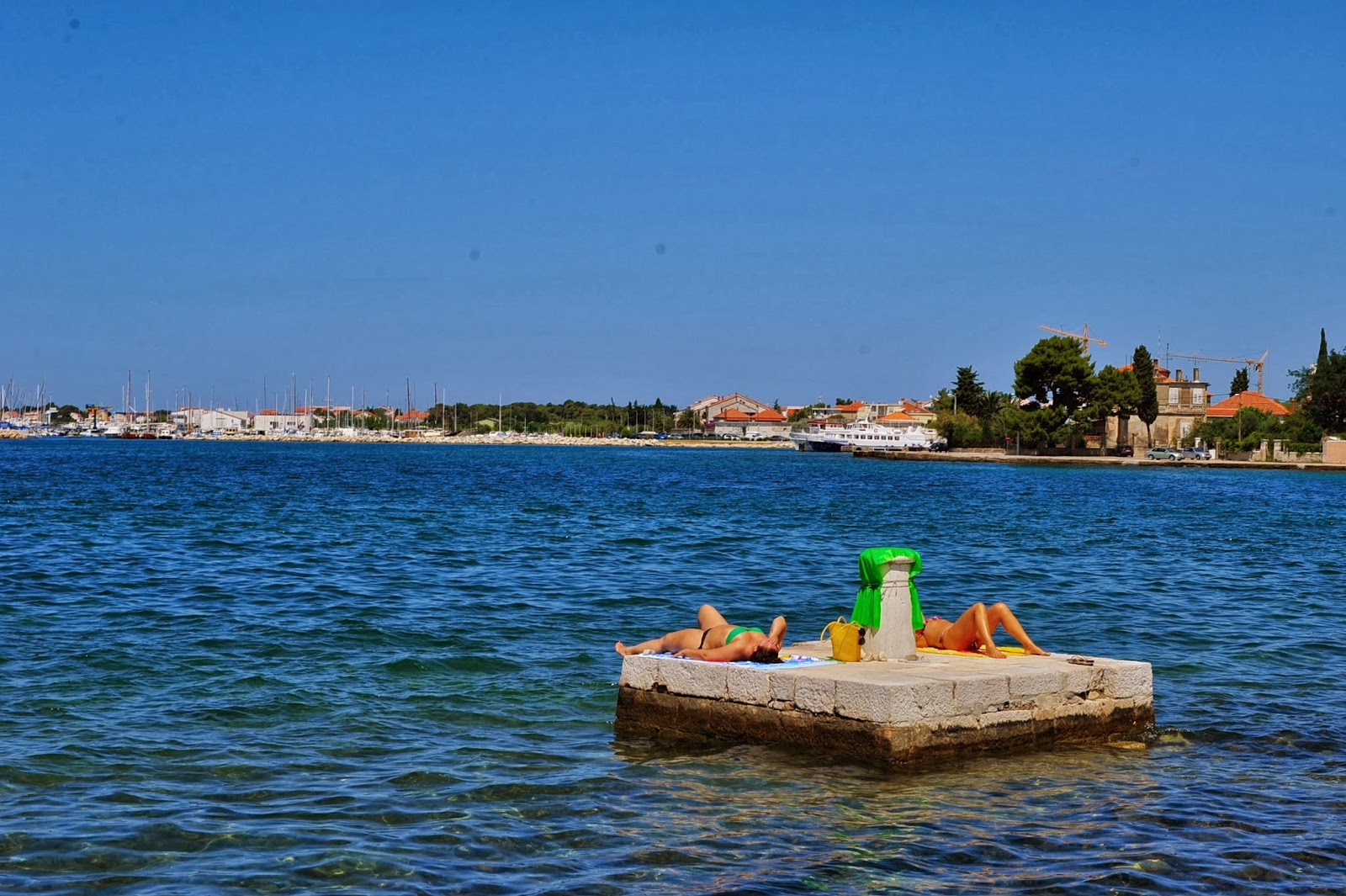
The Dalmatian coast is mostly rock, and some salt-scoured islands feel almost entirely dead.  Real, comfortable, sandy beaches are rare.  Most people sunbathe on concrete slabs.
In Opatija, a city where seafood approaches perfection, we had a barbecue of squid and blitva.  The market where we shopped for our supper was made of Tito-era cement and seemed like the only cool place in the sun-baked city.
The heart of the summer - no rain, mild air, a sense that nothing bad can possibly happen - is best spent in a tent.  We soaked up the sun and got into our sleeping bag coated with salt.  We never went inside.  We ate by the ocean, we napped in the shade, we swam and walked and came home to a crowded camping city that smelled always of grilling sausage and suntan oil.
This was the semi-permanent home of one of our neighbors there at Camping Kovačine - grandparents, small children and at least two couples used this one camper as a base.  Did they all sleep inside?  Hard to tell.
Late one night - well past midnight - we were returning to our campsite in Ičići and came across this streetlight game of volleyball.
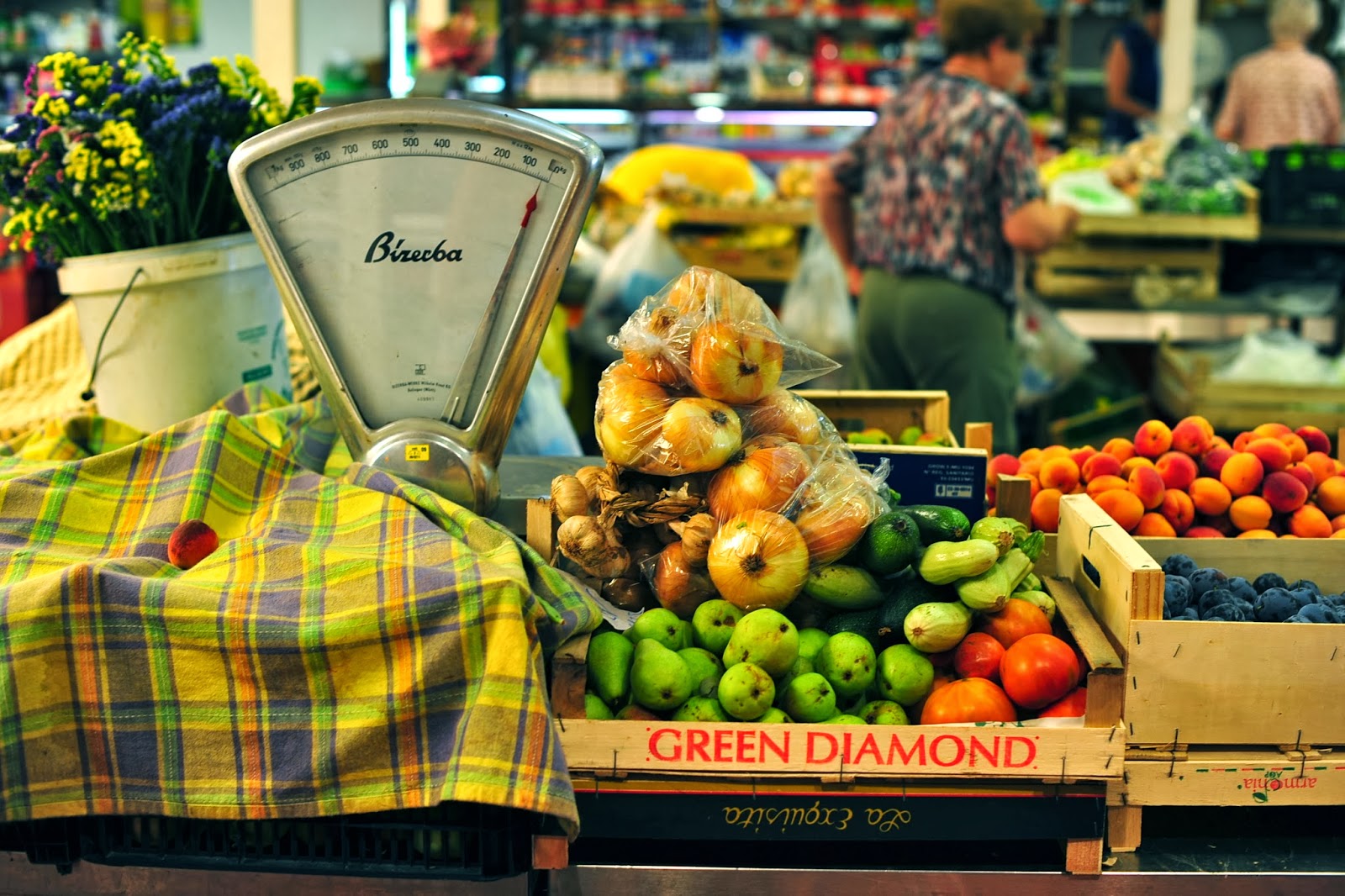
These scales always remind us of communism.  Every market from Minsk to Budapest to Sarajevo is full of them.
We spent a lot of time near the Mediterranean on the trip, but almost always during the colder months.  The summer seashores are too crowded in Malta or Greece or Provence.  At least, they're too crowded for serious travel.
But there we were, in Croatia during the high season.  We succumbed because there was no other choice.  It's Croatia that we think of first when our minds turn to sunny saltwater.  It was unavoidably perfect.  It was a vacation.
To see all our posts from Croatia, just click here.
To see all the Cutting Room Floor posts, with great pictures from the other 49 countries, just click here.
You have read this article Beaches / Camping / Croatia / Cutting Room Floor / Food / Hiking / Marketplaces / Seaside with the title . You can bookmark this page URL https://africathoughts.blogspot.com/2013/12/crf-best-of-croatia.html. Thanks!
Thursday, May 9, 2013

British Food: Neeps, Squeak, Chips and Guts

When the fish hit the fat, it made a racket.  Sputtering, splattering, bubbling and squealing, it cooked fast and hot.  Within a bare few minutes, we were handed our lunch.  It was still hot after we'd walked from chippy ("fish and chip stand" is too long a name for something so simple) to beach, sat down, taken this picture and tasted the fries.  Or, "chips," as we all know they're called. On the Welsh island of Anglesey, in the middle of November, this felt like our most British of meals, and it came so close to the end of our time there.  The haddock was juicy, the crust was crisp, the whole thing tasted of salt and empire.
Beside the fish is a little dish of "mushy peas," which is exactly what it sounds like.
America and Britain are not culturally similar.  Anyone who tells you otherwise hasn't been to both places.  We may speak the same language, but would a typical, small-town American restaurant serve haggis with neeps-n-tatties?  Is blood sausage a normal part of American breakfasts?  Can you imagine supermarket freezers displaying pre-made kidney pie?
Brits love their offal, especially certain pieces in certain places.  Haggis might seem like a joke to us Americans, a weird food that couldn't possibly be common, but it's truly a staple in Scotland.  This plate of haggis (the "neeps-n-tatties" beside it are simply mashed turnips and potatoes) was served to me in a raucous pub in Elgin, which is about as blue-collar a place as there is.  I ate the dish a few other times while in the north, and grew to really like it.  And I really liked it; not as in "it's weird, but I can tolerate it."  As in "I hope they have haggis on the menu!"
It's made from ground sheep's heart, liver and lungs mixed with oatmeal and traditionally cooked in a sheep's stomach.  Nowadays, a plastic casing is often substituted for the stomach.  The flavor is richened with mace, nutmeg, allspice, marjoram, thyme and plenty of ground pepper.  It is so aromatic, so uniquely spiced, that vegetarian versions (using grain instead of organ) tasted undeniably haggis-like.  It really is delicious, and definitely isn't a joke.
Scotland isn't the only country within Great Britain with a signature dish that gets the imagination going.  Welsh rabbit is neither originally Welsh nor made of rabbit.  You'll find it referred to as "rarebit" in Wales, a word invented for the purpose of saying something other than "rabbit" for this meatless dish.  Welsh rabbit originated in England and is, essentially, fondue.  Cheese, usually cheddar, is melted and mixed with ale, mustard, cayenne, wine, what have you.  Then, it's either poured over bread or served with "soldiers" (finger sized slices of toast) for dipping.  So how did this cheesy food, which tastes exactly as you'd expect it would, get named after Bugs Bunny?  The two theories I've read point to the English insulting the Welsh - either that they were so poor, cheese was their rabbit (an animal the English already considered 'the poor man's meat') or that they were so bad at hunting, cheese on bread would be a Welsh rabbit hunter's dinner.
In Criccieth, while walking beneath a seaside castle, we stopped into a bakery.  It was early morning. The sun was coming up over the Snowdon mountains. The town smelled of baking.  We asked the girl behind the counter what these little rectangles were - she'd just pulled them from the oven and they were puffed up and emitting visible plumes of steam.  "These?" she said, giving us a suspicious look. "These are pie."  Pie?
"Yeah," she said. "Cheese pie."  She gave us another funny look.  How could we not identify pie?
In the UK, pie can be fruity, meaty, cheesy, round, square, deep, flat or otherwise.  It seems that if it's wrapped in pastry, it can be called a pie.  This one was mildly cheesy, with a small dose of grassy herbs and sweetish potato inside. It tasted a bit like a knish.

In Hawes, in one of the small stone pubs that dot the Yorkshire Dales, we tried steak, kidney and "Old Peculier" pie.  The beer, which really is spelled that way, made the dish an English take on an Irish classic "steak and Guinness pie."  Fish pies were about the same, with cream replacing gravy and large, pillowy chunks of fish.   It became clear that 'pie' could mean a stew with a puff pastry hat sitting on top or a broiled topper of mashed potatoes.

That's not to say that sometimes a pie is a pie just as you'd want it to be.  The United Kingdom kept our  excellent baked goods streak going.  Through Scandinavia, over to Ireland and now here, it's been three months of excellent whole grains, seasonal fruit and powdered sugar.  It was the stuff of dreams, of magazine pictorials.  And 'stuff' couldn't be a more appropriate word, because there was never a case in which we needed dessert.  We were often full on ale before a meal even began.  And yet...  who can resists?
Once we had 'pies' sort of figured out, there was the whole issue of 'puddings.'

Now, to address the elephant in the kitchen.  Is British food bland?  We can't deny the fact that salt shakers were employed at almost every meal and that things like "mushroom stroganoff" (a vegetarian pub staple) had a dizzying array of ingredients while still managing to taste like nothing at all except for a hard to describe, oxymoronic mix of 'rich' and 'watery.'  But we can't say that this, umm, subtlety of flavor was necessarily the mark of bad food or unskilled chefs.  It's just a style, one that favors the heartier, homier flavors of cinnamon, clove, cream and thyme rather than the punch of salt and spice.  One that prefers you tailor your own dish to your taste with the always readily available supply of condiments.  Above, a selection of packets in a Scottish pub.  Traditional British food may have a reputation for being bland, but does it really get much more British than worcester sauce, HP, English mustard and malt vinegar?

There's all that Indian food if you're looking for something punchier.  Some of the best Indian food of our lives.  It's what Brits eat out, if they're not having stew in a pub.  Like red-sauce Italian food in America, it's not seen as "ethnic" anymore.  We never had a true, traditional afternoon tea - towers of sandwiches, scones, china pots, clotted cream.  Nor did we stop for a "sunday carvery" - a man with a saber, thick cuts of meat, plentiful sides.  But we did eat plenty of curry, saag and daal.  Indian food is popular from London to Inverness, an omnipresent second flavor.  It is also not particularly photogenic, especially in dimmed restaurant lighting on reflective copper dishes.  Instead, we leave you with this picture of a ram.  Lamb or "mutton" is very common in the UK, and at Indian restaurants it is simply referred to as "meat."  Sorry, big guy.
You have read this article Countryside / Food / Seaside / United Kingdom with the title . You can bookmark this page URL https://africathoughts.blogspot.com/2013/05/british-food-neeps-squeak-chips-and-guts.html. Thanks!