Showing posts with label Beaches. Show all posts
Thursday, February 27, 2014

New Eastern Cape Coastal Route to Launch at Indaba 2014

Lions at Pumba
A holiday to South Africa is on most people's bucket list whether it be to achieve a lifelong ambition to go on safari or to visit the Mother City, Cape Town. Visitors travel from far and wide including the UK, Germany, France and the Netherlands and typically stay for a longer period than the average two week holiday. Many visitors choose to hire a car and travel long distances to ensure they take in fully all that this diverse country has to offer. One of the most famous touring routes is the Garden Route which starts around Plettenberg Bay in the Eastern Cape and stretches for 200km down to Mossel Bay in the Western Cape.

At this year's Indaba Tourist Show in May 2014 a new route is being launched called the Eastern Cape Coastal Route. The route will cover over 900km of stunning coastline from Tsitsikamma all the way up to Port St Johns in the Wild Coast. The Eastern Cape Tourism and Parks Agency and Open Africa formed the idea of a new tourist route to promote the Eastern Cape as a holiday destination. Many tourists may not be aware that the Eastern Cape has some of the best Game Reserves in South Africa. Stunning luxury safaris are available at Shamwari, Lalibele, Amakhala and Pumba all located in the Eastern Cape and offering Big 5 game viewing and in a malaria-free environment.

In addition the route will incorporate the Sunshine Coast a stretch of glorious beaches and popular holiday destinations from St Francis Bay up to East London.  Midway along the Sunshine Coast is the coastal town of Port Alfred built around the Kowie River which leads into the Indian Ocean.  Twice a year the Kowie River hosts annual rowing event for the SA Schools and Universities. There is a lovely marina here to accommodate the popularity of deep sea fishing off the coast here. All along the Sunshine Coast you will find coastal holiday spots like Port Alfred including Kenton-on-Sea, Kleinemonde, Hamburg and Kidds Beach.

The new Eastern Cape Coastal Route will offer a huge selection of activities for visitors from fishing, hiking trails, horse-riding on the beaches, diving and surfing. The launch of the route is coinciding with a government initiative to invest in tourism in the Eastern Cape.
You have read this article Beaches / coastal routes / eastern cape / game reserves / holidays / Port Alfred / South Africa / Travel with the title Beaches. You can bookmark this page URL http://africathoughts.blogspot.com/2014/02/new-eastern-cape-coastal-route-to.html. Thanks!
Monday, January 13, 2014

Our 10 Most Popular Posts

Here's is the travel blogging catch-22.  Most people are looking for information about places they plan to visit.  So, millions of people search for things about Tuscany, Paris or Amsterdam's canals.  The most amazing place on earth won't receive much traffic if nobody knows about it.  The problem is, the more popular a place is, the more bloggers there are writing about it.  The chance that someone reads your post about the Acropolis? Slim.

Predicting which of our 700 (plus) posts would get read was almost impossible.  Some of the best things we wrote didn't even get read by our own parents.  Some of our silliest or worst-written bits have became enormously (and embarrassingly) popular.

Our 10 most popular posts (based on Google analytics data and Blogger.com traffic reports) are a mixed bag.  Some are good (number one, thankfully), some began their online life as throwaways (see number nine), some are just weird (number five).  Only one of these posts was specifically designed to attract traffic (number two).
Sometimes we just hit upon something. Cihangir is a hip, young Istanbul neighborhood.  It reminded us of a Turkish Williamsburg and confirmed our belief that renting an apartment is the best way to see a city.  The best neighborhoods are often the best because they don't have any hotels.  Don't get us wrong, the center of Istanbul is as gobsmacking is you'd expect and we never tired of tooling around in search of balik ekmek or The Mussel Man (who we wind up finding in Cihangir anyway).  But the best cities are great because of their ever-changing qualities, their momentum and the neighborhoods defined by the young people there at a given time. 
As bloggers, we found ourselves in a jam.  Here we were in Vatican City, two whole weeks of posting about a very, very small microstate and the pièce de résistance was off limits.  No photos in the Sistine Chapel.  Seriously?  If this were a rule decreed by the pope, the security guards would probably have worked a little harder - or at all - to enforce it.  As it turns out, a Japanese TV company owns the exclusive rights to some of the art world's most famous images because they funded its restoration. (This is after NBC turned down the deal.  Probably because they were too busy fine-tuning  Joey, the Friends spin-off).  Anyway, the whole thing was ridiculous, made only more so by the fact that everyone. was. taking. pictures.  So, we decided to half break the rules and snap some shots, too.  Just not of the ceiling.  We're sure this gets traffic because people are searching to see if photos are allowed in the Sistine Chapel.  Not that finding out is going to stop them.  
8. Georgian Food
We can vouch for the fact that it is very difficult to search for anything about Georgia, in English, without being directed to the state instead of the country.  Using the word "Georgian" helps matters a lot.  This one makes us happy because Georgian food really did feel like a revelation.  The textures and flavors were consistently surprising and delicious.  Pomegranate seeds, crushed walnuts, cilantro,  the best bread of our lives.  And then there were khinkali, the soup dumpling like concoctions pictured above.  In the tiny town of Mestia, at the time the most remote place we'd been, the only restaurant in town basically only served khinkali   We discovered, quickly, that they are so delicious you don't need anything more.
Amazingly, this is only our second most-popular Albanian post (see below!)  
Sometimes we know exactly why people are reading a specific post.  After a TED Blog writer used our photos of Tirana's painted buildings we got a sudden surge of visitors.
The story of Edi Rama (painter turned Minister of Culture turned mayor) and his brilliant idea to transform ugly communist-era cement blocks into bold, bright works of art is a great one.  It's no wonder it's garnered some attention.  We're just happy that our own piece focuses more on the story of the city today and of Malvin, a young man who served us dinner one night and was showing us around the next.  Maybe he'll stumble upon the post himself and shoot us an email.  We wonder if he ever made it to that bioengineering school in Canada.
6. Castle Hunting: Trakai Castle
Island castles are a little bit of a trend (see number 4).
We remember this castle most for the speeding ticket we got nearby.  Lithuanian police take road safety very seriously.  For the record, if you should ever find yourself stopped by an officer in Lithuania, be prepared to pay your fine in cash on the spot.  If you don't have the money, he/she will drive you to the nearest bank to withdraw the amount.  Don't be scared.  This is absolutely normal.  Well, you can still be scared.  As we were.
5. Sleeping In Soviet Style
This little Belarusian piece has always baffled us.  For almost a year it was our number two most-viewed post, second only to this, about Belarusian tractors (which now ranks about 12th).  It would make sense if people were only landing here while looking for lodging in Belarus - which is hard to find - but that didn't seem to be the case.  Inexplicably, thousands of people showed up after searching for "armenian elevator buttons."  The internet is a weird, weird place.
(Thanks to one visitor, we learned that what we thought was a very cool smoke detector was actually an even cooler single-channel radio from the Soviet age).
We were never even supposed to be there in Kizkalesi, but we were finding it a little difficult to catch a boat to northern Cyprus, and we needed a place to stay.  For a Turkish seaside town, it's a little drab.  People visit for the "floating" castle (and visit our blog for pictures of it).  We stayed in an empty hotel, run by a very nice Kurdish man who took us to the nearby Caves of Heaven and Hell and invited us to watch a televised NBA game with him in the evening. 
3. Lithuanian Food
For a long time, Lithuanian Food was the most viewed post on the blog.  It features grainy, unappealing photos of cepelinai, blyneliai and various other cheesy, gloppy dishes.  This is a poorly-lit shot of kiaulės audis, which is smoked pig's ear.  We had no idea - as we crunched cartilage on that dark night in the Žemaitija National Park - that so many people would find this stuff interesting.  Then, again, we may not have ordered the smoked pig's ear if we didn't at least hope they would.
2. Montenegro's Best Beaches
Some day soon, this will be the most read merlinandrebecca.com post.  It's been popular since day one, and it does really well around every vacation time.  Montenegro is newly independent and popular, so there isn't as much written about it as, say, Croatia.  We think that's why readers end up on our site.  This one feels a little bittersweet, though, because we created it while thinking "this will get so much traffic!"  But, hey, the hope is that then you stumble upon something like this.  The other hope is that more people will look beyond the big resorts that are threatening to destroy the coastline and find those little places that remain untouched… for now.
While it's not too surprising that 3 of our 10 most popular posts are about food, Albania sneaking in for the win is a bit of a shock.  Here's our theory:  there's simply not much information available online about Albanian food.  So, unlike a search for "Italian food," you're more likely to stumble upon us.  In fact, googling those two words right now, we're right there behind wikipedia, food.com, ask.com and pinterest (which may or may not have even existed when we published this post).  If the title had been "Frogs Legs and Lamb's Head" - as I'm sure at least one of us wanted it to be - there's no way this would be our number one.  But… hey… we learned a few traffic tips along the way.  Now, add the fact that Albania was named Lonely Planet's Top Destination for 2011 and you've got yourself a winner!
You have read this article Beaches / Castles / Cities / Food / Hotels / Museums / Seaside / Top Tens / Travel with the title Beaches. You can bookmark this page URL http://africathoughts.blogspot.com/2014/01/our-10-most-popular-posts.html. Thanks!
Friday, December 20, 2013

CRF: The Best of Croatia

"CRF" is not a crime show you've never heard of, it stands for "Cutting Room Floor." It's been almost a year since we returned from Europe, and we've started to get seriously nostalgic.  To give us all an extra travel fix, we're posting some of our favorite photos that never made it onto the blog.  Here are our favorite unpublished memories and pictures of Croatia.
More than any other country, we associate Croatia with hedonism, sun and the scent of saltwater.  Our trip never felt like a vacation, but Croatia is a vacation by definition.  Everyone there was on holiday in one way or another - it was the same for the naked Germans and drunk Russians and sunburned Brits that joined us on those rocky shores.  It was July.  The sun never seemed to go down.
For a few happy days, we stayed at a huge campsite on Cres Island.  There was squid to eat in town and beer to sip on the long oceanside promenade.  When we swam, we were stung by tiny jellyfish.  When we walked in the balmy evenings, we listened to cicadas and waves.  Nearby, in a pine forest, a rusty amusement park spun its blinking, neon magic.
At home in the US, not long after the trip, someone told us that Croatia sounded "scary and Russian."  It's true that in some places, like Zadar, one can find bomb-scarred buildings from the Balkan wars - but you have to look hard.  The scariest thing about Croatia today? Probably the spiny sea-urchins that lurk in the shallow water.
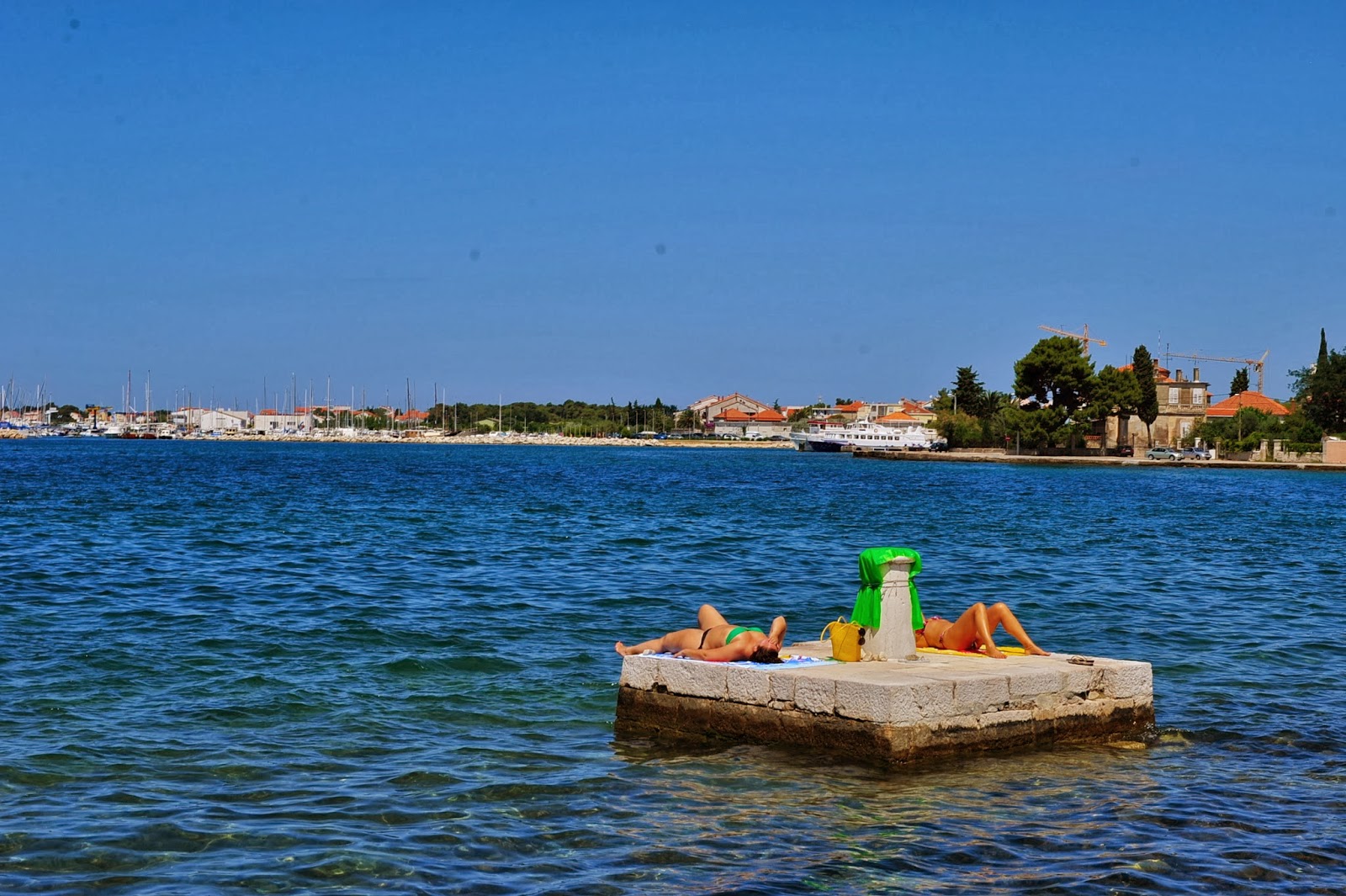
The Dalmatian coast is mostly rock, and some salt-scoured islands feel almost entirely dead.  Real, comfortable, sandy beaches are rare.  Most people sunbathe on concrete slabs.
In Opatija, a city where seafood approaches perfection, we had a barbecue of squid and blitva.  The market where we shopped for our supper was made of Tito-era cement and seemed like the only cool place in the sun-baked city.
The heart of the summer - no rain, mild air, a sense that nothing bad can possibly happen - is best spent in a tent.  We soaked up the sun and got into our sleeping bag coated with salt.  We never went inside.  We ate by the ocean, we napped in the shade, we swam and walked and came home to a crowded camping city that smelled always of grilling sausage and suntan oil.
This was the semi-permanent home of one of our neighbors there at Camping Kovačine - grandparents, small children and at least two couples used this one camper as a base.  Did they all sleep inside?  Hard to tell.
Late one night - well past midnight - we were returning to our campsite in Ičići and came across this streetlight game of volleyball.
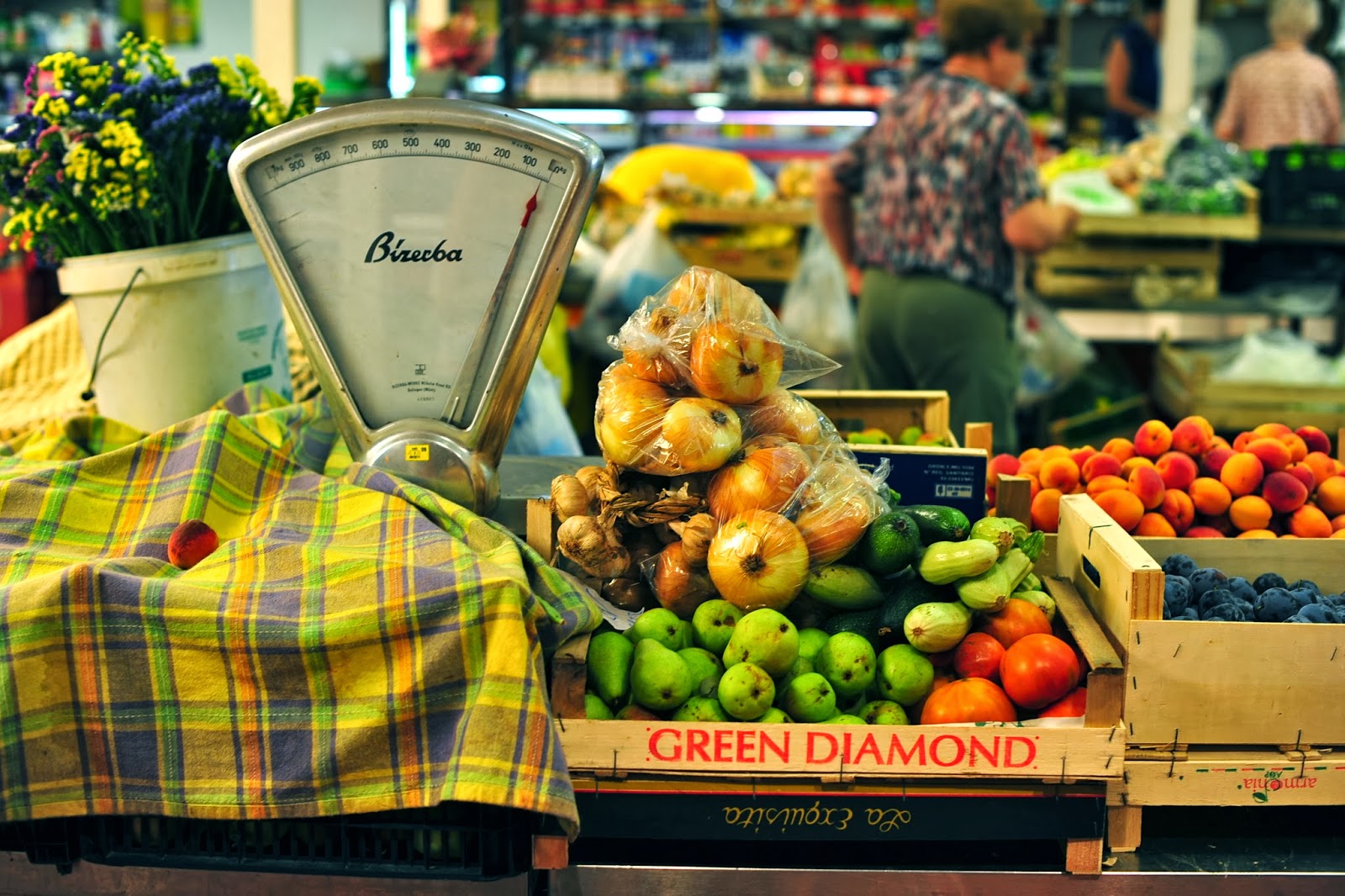
These scales always remind us of communism.  Every market from Minsk to Budapest to Sarajevo is full of them.
We spent a lot of time near the Mediterranean on the trip, but almost always during the colder months.  The summer seashores are too crowded in Malta or Greece or Provence.  At least, they're too crowded for serious travel.
But there we were, in Croatia during the high season.  We succumbed because there was no other choice.  It's Croatia that we think of first when our minds turn to sunny saltwater.  It was unavoidably perfect.  It was a vacation.
To see all our posts from Croatia, just click here.
To see all the Cutting Room Floor posts, with great pictures from the other 49 countries, just click here.
You have read this article Beaches / Camping / Croatia / Cutting Room Floor / Food / Hiking / Marketplaces / Seaside with the title Beaches. You can bookmark this page URL http://africathoughts.blogspot.com/2013/12/crf-best-of-croatia.html. Thanks!
Saturday, July 21, 2012

Montenegro's Best Beaches

In seaside Montenegro, it's rare to find a place where swimsuits aren't appropriate attire.  In restaurants, bars, at crosswalks and in cars, in supermarkets and boutiques, everyone wears them.  Budva is a city where the bikini is the default dresscode, where people walk on the sidewalk in trunks, carrying their shopping.  One half expects to see lifeguards set out as traffic police.
Montenegro might seem like a beach lover's paradise - it has the blue water of the Adriatic, dramatic coves, lots of sun, bountiful seafood and throngs of young people.  But, to tell the truth, it can be a little difficult finding a good spot to lie down by the shore.  Most of the coast is too rocky and cliffy, a lot of the best beaches are overdeveloped and over-packed.  To find a perfect idyl takes some time and patience.
We traveled much of the short seashore, but obviously didn't make it to every stretch of sand - here, though, are our favorite Montenegrin beaches.
Sveti Stefan is one of Montenegro's most iconic sights, a little protrusion of red tile and white stone jutting out into the warm water.  The beach here is sandy, protected and kept very clean - apparently.  We never set foot on it, though we passed it every day for nearly a week. It's impossible not to include, though, because of how pretty it is, and how majestic is the setting.
Unfortunately, the parking situation is a nightmare and we were deterred by both the other drivers and the extremely hazardous turnoff.
For a few days, we bought our milk and yogurt in Petrovac, at a grocery store full of sunburned families in flip flops.  It's a family resort, with a promenade full of strollers and more sunblock than tanning lotion.  Petrovac also has one of the most scenic town beaches, with rocky isles just beyond the bay and high-sided bluffs set on either side.  The sand is reddish and fine, there are lots of appetizing cafes the water is clear.
A very foreign concept to most Americans is the idea of renting a beach umbrella and loungers - but it's the default way for European sun seekers to set up camp by the shore.  At home, we either bring an umbrella or go without shade, and tend to lie on towels.  Here in Montenegro it's possible to lie by yourself, but it's seen as somehow cheating.  Most people pay the few euros for shelter and comfort.
Down beneath rows of kebab stands and backed by minarets, Ulcinj's Mala Plaza has a distinctly Albanian feel.  This close to the border the music changes to more warbled tones, the language landscape shifts and the visitors are almost all from Kosovo and Albania.  Ulcinj has its own energy, a cultural hedonism mixing Islam and bikinis, halal and beer.  The remains of an old castle buttress one side of the beach, the sand is pleasant, the vibe is more boisterous than other Montenegrin beaches.
Tiny, beautiful Rose (pronounced like the wine) is at the remote tip of the Luštica peninsula, jutting out into glass-clear waters and more in touch with the sea.  We stayed the night here, eating great seafood at a waterside konoba and smelling the fresh wind off the open water.  In the country, it's known as a somewhat glamorous locale, but it's not big enough to get overrun.  Diving from the pier into the water is like finding a pocket of heavy, cold atmosphere - the light from the surface dances on the deep rocks, one can see fish darting in the depths.
The only problem is that there's no real "beach."  People lie and swim from the concrete platforms, in a way that reminded us of nearby Croatia.  Tanning on concrete feels like a more extreme form of intake, as though the sun is hardened as it strikes and ricochets from the plane. Where there's no sand or pebbly wash, this is what one has to make do with.
Far away from the sea, in water much calmer and environs less visited, the beach at Murici, on Lake Skadar, felt like a refuge.  Fishermen docked their boats there and the pace was as slow as the days were long.  The light faded gradually from the sky in the evening, leaving us feeling drained and peacefully silent.  Sleeping here is limited to camping or bungalows, the resorts of the coast feel like a different concept of "waterside."
We loved the beach, though it's gravel (to be truthful) and the water is shallow for a very long ways.  It's a sliver of hospitable shore in a landscape dominated by cliff and rock, algae and weeds.  The freshwater swims we took felt luxurious after so much Mediterranean salt.
The most prototypically "perfect" beach in Montenegro is almost certainly Przno beach - not the oiled up, hyper-touristy strip in Budva with the same name, but a different Przno.  Tucked away in the last, wild bay before the Gulf of Kotor, it's visited mostly by Montenegrins in the know and adventurous tourists with their own car.
Here, the water is very shallow for a long way, but the powdery, white sand and calm ripples make it worth the effort spent wading.  Because the beach is so sheltered and the water is so easygoing, it's a popular place for families with young children.  There are picnic tables in the woods around, and a shady, open-air restaurant tucked into the fig trees behind.  Przno is the kind of tropical beach that would be loved anywhere, from the Caribbean to the South Pacific - the shallow, aquamarine water and soft sand feel familiar in a postcard way, the view is of gentle lines, the umbrellas are (at least) well spaced.
Swimming at Drobni Pijesak, looking back towards the mountains and scrub, one can truly feel that they are somewhere remote.  It's one of the few nice beaches in Montenegro that doesn't yet have a forest of condominiums behind it, and it's hard enough to get to that it remains mostly uncrowded.
With white pebbles and a verdant frame, Drobni Pijesak is undoubtedly one of the most beautiful on the coast, but there is very limited parking nearby the water, so most have to walk a precipitous path down from the main road.  It's a trek steep and long enough - about twenty minutes - to keep away the crowds, and there's a nice little cafe tucked into one corner.
Down a long walkway that begins amid stone walls, passes through thick oleanders and then weaves under pine boughs, our favorite beach was also the harshest textured.  The little strip of rock and pebble hidden below Rijeka Rezevici isn't perfect to lie on, but it is a wonderful place to sit, swim and eat.
The water here is full of boulders that hide schools of minnows, quick bream and mullet.  There are hundreds of sea urchins, too, and an altogether wild feel that makes this little cove feel exciting.  It's the world of shipwrecks and skinned knees, of a secret pocket of Adriatic life.  The water is wavy and redolent of salt, there are rarely more than twenty people.
At Balun restaurant, tucked just above Rijeka Rezevici's beach, we ate expertly cooked meals of fresh seafood and fresher vegetables.  Approaching the restaurant, the trail through the woods enters Balun's vegetable garden: vines hung with tomatoes and dusky peppers, rows of lettuces, stone-edged plots of roots.  Our affable waiter told us that they employ one man solely to haul all of the rest of their ingredients (and alcohol) down to the water every evening - and to trudge back up with the trash.  It's a steep, fifteen-minute hike.  "Strong legs," the waiter said.
We ate silky cuttlefish risotto one night and a melange of grilled squid, octopus and carrot during another sunset.  The tables are painted wood, set out under the stars.  There are paintings hung on trees.  The sun's last blazes are especially vibrant here.  The clientele is always excited - it feels magical to have found this place, this beach.  It's so isolated and thrilling, a piece of the Adriatic where the breeze and the bobbing boats inspire energy instead of sloth.  
You have read this article Beaches / Food / Montenegro / Seaside with the title Beaches. You can bookmark this page URL http://africathoughts.blogspot.com/2012/07/montenegro-best-beaches.html. Thanks!
Wednesday, May 7, 2003

Expand your horizons on holiday in South Africa

When it comes to holidays; we are all guilty of it – sticking to our usual activities, swimming, relaxing, eating out, sunbathing, etc. How many of us choose a fabulous new holiday destination and come back thinking…  “well we had a good break but did we really experience the country we have just been to?”. 


Too many of us stick to our hotels and the trips on offer to us. With just a little research and an appetite to try out new experiences we can truly expand our horizons. 
When it comes to a destination such as South Africa; it is easy to get sucked into the classic holiday of Cape Town, Garden Route and Safari. Please don’t get me wrong these are good places to go but really only scratches the surface of what there is to do in this vast and culturally diverse country.
So let’s take the example of a Safari. Instead of taking the normal type of safari, why not consider a horse-back safari or perhaps a quad-bike safari. 

Both of these provide a uniquely different type of safari experience and miles away from the usual experience of queuing with lots of other tourists on the more typical jeep/minibus safari. 
If you are struck by the horse-back experience then why not try out one that includes a beach ride as well. The coastline along the Indian Ocean has vast expanses of deserted sandy beaches with huge sand dunes and you get the chance to ride through the shallow waves – a truly magical experience.
The countryside across South Africa is beautiful and just waiting to be explored. In the KwaZulu-Natal province you can discover the amazing Drakensberg Mountains where you can walk miles along hiking trails. The scenery is stunning with San Bushman caves just waiting to be discovered. Many of the peaks have names around the Drakensberg with Cathedral Peak being one of the best known. A trip up these mountains is well worth it especially on a sunny day with stunning panoramic views to be found.
Dotted all around South Africa you can find also Canopy Tours. These are a series of roped walkways between wooden platforms set high up in the forests.   Guides will take you through the forest where you can experience a truly different perspective of life in these indigenous forests. One place you can do this is at the lovely Tsitsikamma National Forest.
Many people visit the Garden Route driving through this pretty route en route from Cape Town. The route follows the Indian Ocean passing though or close to many pretty coastal villages and towns. But did you also know that you can try parasailing from one of the mountains that follow the route too. This is a fantastic experience soaring high above the route with amazing views of the Indian Ocean.
I have tried to give you just a few ideas but there are so many more. By exploring the web you can discover many other wild and different ideas for your trip to South Africa. Just think of all the photo opportunities you will get and be able to share with your friends. So next time you visit our wonderful country take the time out to try a few new ideas – you won’t be disappointed.

For more ideas on things to do in South Africa; accommodation and places of interest - go to www.Where2Stay-SouthAfrica.com
You have read this article accommodation / adventure / Beaches / canopy tours / cape town / explore south africa / FIFA World Cup / garden route / Hiking / Hotels / safari / South Africa / Travel / walking / wildlife with the title Beaches. You can bookmark this page URL http://africathoughts.blogspot.com/2003/05/expand-your-horizons-on-holiday-in.html. Thanks!
Monday, April 28, 2003

Beyond the Obvious South Africa

This 2 day walk through the wonderful Garden Route which covers approximately 35 km, starting in Mossel Bay and ending at Fransmanshoek.

Day 1
From Mossel Bay; head west across the rocks and along the coastal path over the great cliffs overlooking the beaches and deserted sand dunes. This 'off the beaten track' route affords you amazing views, taking you along paths where you will come across the famous fynbos that attracts so many botanists to the area. Did you know that on Table Mountain there are over 9,000 species of plant - more than you will find in the whole of the UK?
 This area is famous for the "Xhosa" (pronounced Corsa) people who have inhabited this area for many years. Many famous South African politicians are from the Xhosa tribe including Mandela, Mbeki and Tambo.  Xhosa people are famous for their language which consists of words mixed with "clicks" - if you get the chance to hear someone speak Xhosa it’s amazing!

Walking along this route you will eventually come to the Pinnacle Golf resort which demonstrates the delicate eco-balance that the Garden Route faces. The Garden Route has become extremely popular with the wealthy, the prosperous and of course tourists. Pinnacle Point will eventually have 850 houses next to a golf course which is situated on the cliff top. In contrast, immediately below the cliffs, archaeologists have discovered caves with evidence of life possibly tracing back to the origins of man. This amazing discovery may one day become a tourist attraction in itself.

From here, the cliffs begin to drop and you are at the end of your first day walking. If you take this walk at the right time of year (July to October) then you may be fortunate enough to spot Southern Right Whales just off the coast line. The whales frequent these waters to play, mate and calve and watching these mammals up so close is an amazing experience.

Day 2
Day 2 begins with a long walk along wide open sandy beaches along the Indian Ocean shore. With the enormous sand dunes behind you - some 030 metres high; it’s impossible to resist the urge to take your shoes off and wade into the Ocean. You will possibly spot the rare African Oyster Catcher along this route as well as people fishing for oysters in the rock pools close to the sea shore. This is a beautiful walk but if you venture up into the sand dunes keep a look out for leopard prints in the sand - yes that's right! leopards do visit down from the mountains but you are highly unlikely to see one.

You will eventually come to the village of Vleesbaai and from here you can take a path along the seashore towards the jagged rocks of Fransmanshoek and the end of your trail. From here you can look back and view almost the whole two day route you have just walked all the way from Mossel Bay.
For more information and accommodation options, go to www.Where2Stay-SouthAfrica.com 
You have read this article Beaches / garden route / Hiking / Nature / South Africa / walking / wildlife / world cup 2003 with the title Beaches. You can bookmark this page URL http://africathoughts.blogspot.com/2003/04/beyond-obvious-south-africa.html. Thanks!