Pieces of the only surviving gown belonging to Marie Antoinette. A u-boat reconnaissance helicopter. Four hedgerow mazes. A museum dedicated to old groceries. Another museum of Falck rescue vehicles, another of dolls, a barn of old farm equipment, more than a hundred motorcycles, planes, Parisian dresses, American cars, African shields, scent gardens, comic strips, folding campers, novelty bicycles, rare stamps, Japanese lanterns, chicken coops, treetop walkways, license plates, hotdog stands, cursed figures, impala heads... even
Dracula's crypt! It's all at Egeskov Slot, one of the most interesting and strange places we've ever walked around. Containing no less than eight on-site museums, this is a castle experience that only just begins with bricks and arrow slits.
Egeskov castle lies at the end of a long, treelined allé in the flat countryside of Funen Island. It's an interesting structure (billed as "Europe's best preserved renaissance water castle") that we'd come to for a
castle-hunting post. The sky was grey, though, and the light was too flat for good pictures. Funen - sometime's called "Denmark's larder" - is a low, central isle covered in beet fields and dotted with beef cows. We passed thatched roofs and half-timbered houses on our way to the castle, all cloaked with fog and buffeted by the damp sea-wind.
If the weather was disappointing, what we found wasn't. Let's put it this way: we arrived at Egeskov a few minutes before the gates opened at 10:00. We left at three-thirty, half an hour before closing. And there was
still more to see. Here, a remote-controlled, steam-powered toy boat splashes and puffs its way around the castle lake. It let out intermittent whistles and made a delightfully self-important gurgling, chugging sound.
The name
Egeskov means "oak forest," which refers to the one thousand oak pilings that the castle is built on. Originally constructed in 1554, the fortifications are actually on the surface of the water - surprisingly, it hasn't sunk much in the centuries since. The sight is staggering even in dim conditions - it's the kind of place one assumes couldn't really exist.*
The castle's biggest enthusiast, probably, is the current owner and inhabitant, Count Michael Ahlefeldt-Laurvig-Bille. He appears on the castle website, in the brochures and in several on-site videos. His exploits are told and retold on different info-boards: he rescued an ancient Harley Davidson from a recluse's garage, he built the world's biggest maze, he "thoroughly explored" the castle moat (Michael's a "keen diver") and dredged up old plates and canons. We laughed when we read this bit of pomp on the official website: "Legend has it that, in the mid 1960s, a boy was born to the name Michael Ahlefeldt-Laurvig-Bille. Today he is the Count at Egeskov and lives in Egeskov itself."
*
Not only does it exist - there are TWO Egeskov's. A one-to-one replica was built as part of the Hokkaido Aquarium, in Japan, which is truly bizarre. We laughed again when we read about the count's very own suit of armor (the same one he wears on the
website). An information board tells how having the armor made fulfilled "a childhood dream" for the count. Supposedly, it's an exact replica of the suit worn by a distant ancestor, Frands Brockenhuus - we're betting that old Frands also had a taste for the dramatic, because the piece was absolutely festooned with weaponry and covered in gold details.
Egeskov - the building - is packed to the rafters with bits and pieces from several lifetimes of collecting. The bottom floor is given over, in large part, to hunting trophies from the current count's grandfather. Under the eaves is a strange array of windup toys and an impressive model train. There's victorian cookware, furniture from the court of Louis XVI, old paintings, several pianos, aspic molds, rare books, metal chests, family trees and louche knick-knacks. The staff does an admirable job of dusting, but the place still feels a bit like an overcrowded antiques shop.
Fittingly, the prize attraction at Egeskov is
another overstuffed house... this time in miniature. Titania's palace is advertised as "probably the most fairytale dolls' house in the world," which is actually a bit of an understatement. Dreamed up and built by the Englishman Sir Nevile Wilkinson for his daughter, Gwendolyn, the palace is crammed with minuscule artifacts collected over fifteen years. The world's smallest working church organ, for example, and several dozen rare, coin-sized books. In all, there are over three
thousand pieces in the doll house. Tiny photographs, little snowshoes, mahogany furniture, bathtubs, teddybears the size of ladybugs, porcelain figurines and potted plants fill the 18 rooms. The decorative style is pure victorian overstuff. It draws a crowd.
Count Michael's parents had already opened up the family home to paying visitors in the 1980's, and one has to assume that the 200,000 annual visitors are let in to pay for upkeep - it's not a cheap ticket, castles (especially ones built on the water) are expensive to maintain. We couldn't help but wonder, though, if our host didn't relish the attention.
For all his boasting, Michael has made his home really fun. A birdsong walk snakes through the treetops (like a
small-scale baumkronenpfad), there are stilts to use, a maze to explore and, of course, Dracula's crypt... which could never be adequately explained. The exhibits are so diverse that it would be impossible to visit and not find something of interest. If motorcycles aren't your thing, you might like the French fashion magazine illustrations or the old harvesting machines.
The end of October is a slow time in Denmark. The country's tourist attractions are winding up their summer hours, the days are getting dark and short, the country roads are nearly deserted. We toured Egeskov on the last day of autumn break, before all the schoolchildren headed back to their desks and their parents went back to work. It was Egeskov's last day open until spring. A few special exhibitions were going on - in the Falck museum, some remote-controlled truck devotees were driving and talking about their semis. In the main barn, where the bulk of the airplanes and cars are kept, a model steam and gas engine show was happening. Stacks of
Popular Mechanic lay on the tables next to working airplane miniatures and chuffing steam cranks.
The cars were an eclectic mix of Detroit (lots of Cadillacs and Fords), Germany (especially Mercedes) and some more exotic brands (Ferrari, Morgan, a schoolbus-sized Rolls Royce, electric one-seaters, Danish bubble cars). Overhead hung an ultralight and a few small airplanes, a float helicopter sat on the mezzanine, rickshaws and camper vans crowded into the corners.
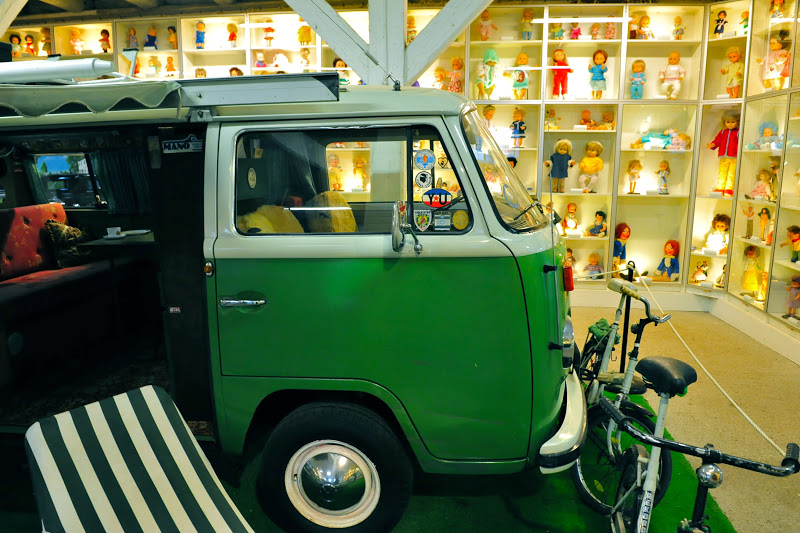
Such is the breadth of Egeskov's collections that some pretty serious contrasts happen in the spaces where two museums collide. Troll dolls rub up against bicycles, kitchen pots are hung next to spring-powered monkeys, hunting trophies bristle on the same wall as collectable postage. There are even little mini-collections that seemingly have no real place, and so are stashed away in some incongruous spot. In the middle of the motorcycles, for example, we found a display of wooden farm animals. Here, plastic dolls surround one of half a dozen campers.

What do you do when you inherit a family castle, your parents collections, your grandparents cars, ancestral hedgerows and formal gardens? It must, in some ways, be tempting to sell the whole thing and walk away from the junk and the cobwebs, the headache of keeping everything dry and upright. Or, as many European castle owners do, rent the pile out to vacationing oligarchs and live somewhere else. Count Michael seems like a different sort, though. He's not only embraced the chaos, he's added to it - particularly in the motorcycle department.
When we caught the bus back to our seaside rooming house, we wondered what the place is like in the offseason. Egeskov is technically closed from now until April, but it's still a home. We pictured the count (and countess, Michael is married) roaming the hallways, dreaming up new exhibits and scarier touches for his crypt, starting up his motorcycles and sitting in the old cars. We wondered if he skated on the frozen moat or ate dinner in the big feasting hall. It must feel very empty once all the tourists have left and the staff's gone home. When you live in a museum, do you prefer to have it full of people or all to yourself?